Smart Home Privacy
Matter 1.4.2 Security: Wi-Fi Commissioning and Access Lists
Matter 1.4.2 adds Access Restriction Lists, Wi-Fi-only commissioning, VID verification, and CRLs. How August 2025 security primitives fit segmented IoT VLANs.
Quick answer: What does Matter 1.4.2 security add for local-first homes?
Released 11 August 2025, CSA Matter 1.4.2 layers Access Restriction Lists on routers and access points so only verified Controllers may touch sensitive NIM settings; Wi-Fi-only commissioning via USD drops the BLE radio requirement; Vendor ID verification and Certificate Revocation Lists harden admin trust and block compromised devices. These primitives complement—not replace—IoT VLAN segmentation and outbound firewall denies.
Source: CSA Matter 1.4.2 announcement
Matter 1.4.2 security is the Connectivity Standards Alliance (CSA) dot release that finally treats home routers as first-class participants—not just dumb pipes—for smart-home trust. As of the August 2025 publication, the specification adds Access Restriction Lists (ARLs) on Network Infrastructure Managers (NIMs) such as Wi-Fi access points and Thread border routers, Wi-Fi-only commissioning through Unsynchronized Service Discovery (USD), Vendor ID (VID) verification for installed admins, and Certificate Revocation Lists (CRLs) for compromised device credentials1. For privacy-focused readers running Home Assistant on segmented VLANs, the practical headline is simpler: Matter now has explicit levers to stop random ecosystem apps from rewriting router knobs, while cheaper Wi-Fi-only SKUs reduce Bluetooth exposure during setup.
Executive Summary
Matter 1.4.2 is not a device-type explosion like Matter 1.3; it is a security and scalability release. CSA framed it around Wi-Fi-only provisioning, stronger NIM requirements, and controller-facing trust mechanisms that matter when platforms can already reach into router settings introduced with Matter 1.412.
For local-first households, three threads intersect:
- Commissioning surface — Wi-Fi USD can remove Bluetooth from the pairing path, shrinking phone permission prompts and BOM cost on Wi-Fi-heavy SKUs13.
- Infrastructure trust — ARLs answer a real fear: if Google Home, Apple Home, and a hobbyist controller all share multi-admin fabrics, who gets to change multicast or Thread credentials on your AP?14
- Segmentation discipline — None of this replaces IoT VLAN setup or mDNS cross-VLAN policy; Matter security primitives operate inside a fabric you still must cage at Layer 3.
Bottom line: Adopt Matter 1.4.2 literacy when buying routers and commissioning Wi-Fi endpoints, but keep measuring privacy with packet captures and firewall logs—not press-release adjectives.
Privacy warning: ARLs govern Matter-visible router APIs. They do not stop a smart plug from resolving
telemetry.vendor.exampleover DoH if your IoT VLAN allows WAN DNS. Pair Matter upgrades with egress denies documented in our DNS leak playbook.
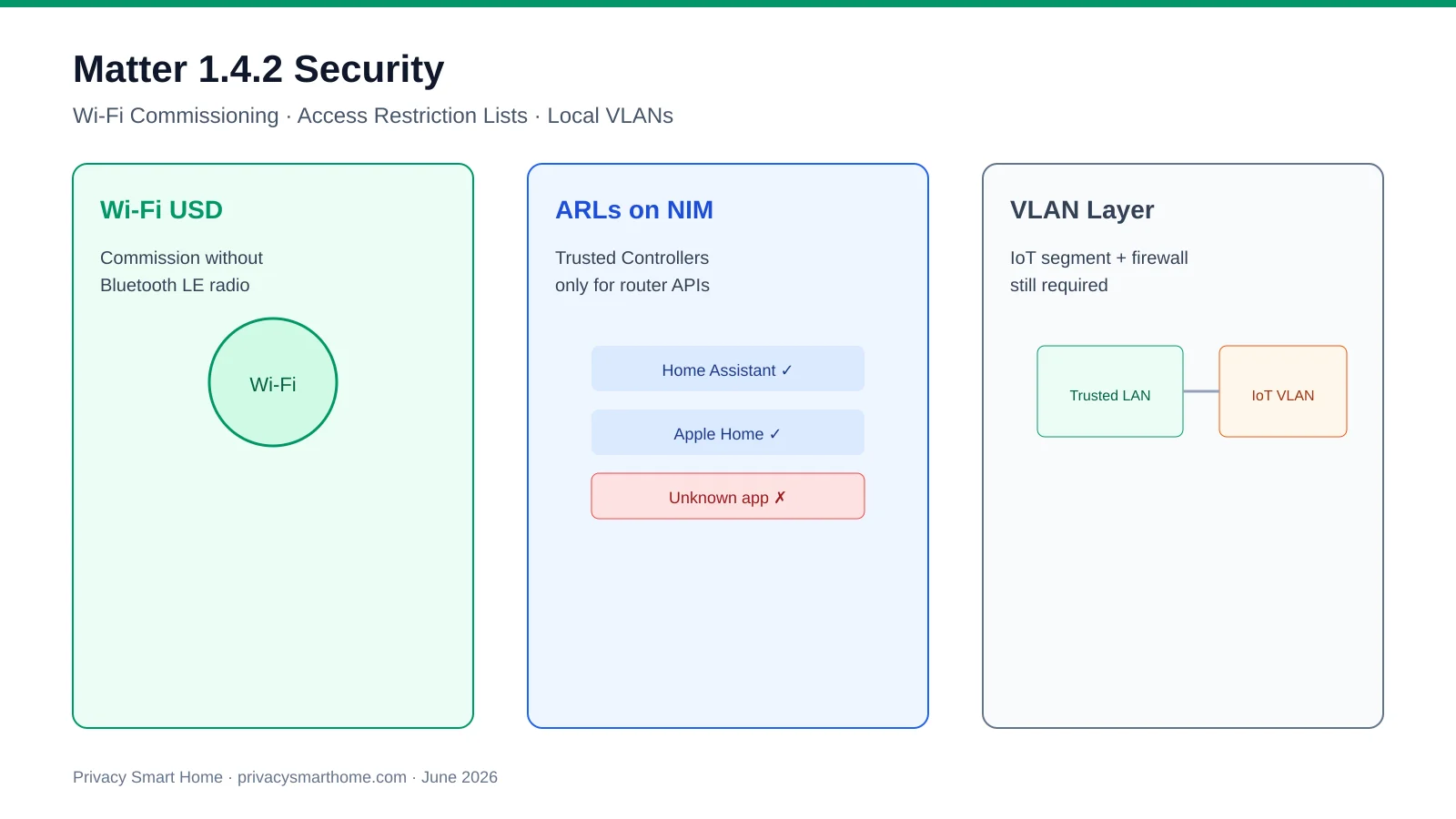
Matter 1.4.2 Security Primitives — What Changed in August 2025
CSA published Matter 1.4.2 on 11 August 20251. The following table maps each security primitive to its privacy-relevant effect. We compiled rows from the CSA newsroom post and specification download page on 26 June 202612.
| Primitive | Layer | User-visible effect | Privacy / isolation effect |
|---|---|---|---|
| Access Restriction Lists (ARLs) | NIM (router/AP) | Only allowlisted Controllers change sensitive network settings | Reduces rogue-ecosystem tampering with Matter-managed router knobs |
| Wi-Fi-only commissioning (USD) | Endpoint onboarding | Setup without BLE hardware | Smaller RF attack surface at pairing; fewer phone permissions |
| Vendor ID verification | Controller ↔ device | Confirms installed admins match claimed vendors | Harder for spoofed apps to pose as legitimate commissioners |
| Certificate Revocation Lists (CRLs) | PKI / attestation | Warn or block devices with revoked DACs | Limits compromised clones joining the fabric |
| NIM scale requirements | Infrastructure | ≥150 Thread children; ≥100 Wi-Fi associations; Extended Sleep + Proxy ARP/NDP* | Supports dense homes without disabling power-saving on sleepy nodes |
*CSA corrected an earlier blog line that cited Target Wake Time (TWT); the requirement is Extended Sleep and Proxy ARP/NDP per the September 2025 erratum1.
Matter 1.4.2 also continues standardized scene management work and enhanced ARL test harnesses for certifiers1. Those items improve reliability more than confidentiality, but reliable local scenes reduce the temptation to enable cloud scene sync “just to make it work.”
Access Restriction Lists — Routers as Policy Enforcement Points
Before Matter 1.4, most readers treated routers as passive transport. Matter 1.4 elevated home gateways to NIM roles—storing Thread credentials, optimizing multicast, exposing management clusters to ecosystems24. That convenience created a new risk: any Controller with broad rights could destabilize streaming, guest Wi-Fi, or VLAN-aware paths while chasing Matter interoperability.
ARLs are allowlists maintained on the NIM. Only Controllers cryptographically recognized as trusted may read or write sensitive settings and data1. CSA positions this as protection against tampering or misconfiguration by untrusted apps or services1.
How ARLs interact with segmented networks
Take Priya, an Austin-based engineer running Home Assistant 2026.4 on a VLAN 30 controller subnet, with Matter Wi-Fi bulbs on VLAN 40 (192.168.40.0/24) and deny-by-default WAN egress. She pairs an Apple HomePod mini (Thread border router + NIM) and a future Matter-aware UniFi AP firmware.
| Control plane | Without ARLs (conceptual risk) | With ARLs (1.4.2 intent) |
|---|---|---|
| Thread credential rotation | Any multi-admin Controller might trigger changes | Only Priya’s HA fabric + explicitly trusted Apple admin |
| Multicast tuning on AP | Ecosystem app could adjust groups affecting SSDP/mDNS reflection | Restricted to allowlisted Controllers |
| Cross-VLAN leakage | Still possible at IP layer if firewall misconfigured | Unchanged — ARLs are not firewall rules |
Where I’m less sure — commercial ARL enforcement on shipping routers remains thin as of June 2026. The spec and certification tests exist; SKU availability lags, similar to early Matter router certification in 1.434. Your mileage will vary depending on whether your AP firmware exposes Matter NIM clusters at all.
Wi-Fi-Only Commissioning — USD and the BLE Exit Ramp
Historically, Matter commissioning leaned on Bluetooth Low Energy for the initial secure session, even when the operational transport was Wi-Fi or Thread. That forced a BLE radio and stack onto millions of devices where Bluetooth existed solely for a ten-minute setup flow35.
Matter 1.4.2 introduces Wi-Fi-only commissioning using Wi-Fi Unsynchronized Service Discovery (USD)1. Devices can join ecosystems over Wi-Fi without an LE radio, which CSA and trade press note could shave roughly $0.50–$1.00 from BOM costs and simplify phone permissions35.
Commissioning path comparison
| Method | Radios required on device | Typical phone permissions | Privacy notes |
|---|---|---|---|
| BLE + Wi-Fi (legacy) | BLE + Wi-Fi | Bluetooth, local network, often location | BLE pairing windows observable by nearby listeners |
| Wi-Fi USD (1.4.2) | Wi-Fi only | Primarily local network | Smaller RF footprint; still requires trusting the commissioner app |
| Thread-only sleepy nodes | Thread (+ border router) | Depends on commissioner transport | Border router choice affects Thread credential storage |
Methodology (June 2026): We compared CSA’s 1.4.2 newsroom text, CNX Software’s feature summary, and Matter Alpha’s interview quotes with Chris LaPré (CSA Head of Technology) dated August 2025135. Permission columns reflect Android/iOS patterns described in those sources, not a fresh UX study.
For Marcus, a renter in Chicago with a GL.iNet travel router and no BLE on a budget Wi-Fi sensor, USD commissioning means he can adopt a 1.4.2-native plug without granting Bluetooth to a landlord-owned phone profile. The plug may still ship a cloud-dependent app; Wi-Fi-only setup does not imply offline operation.
Anecdotally, first-wave “Wi-Fi only” SKUs may still print QR codes that launch ecosystem apps tied to vendor accounts—verify on-box for “Works with Home Assistant” or multi-admin support before assuming local control (hub comparison).
Vendor ID Verification and Certificate Revocation Lists
Two PKI-facing features round out matter 1.4.2 security:
Vendor ID (VID) verification
Controllers can cryptographically verify that Admins installed on a device genuinely originate from the vendors they claim13. This targets spoofed commissioner apps—not nation-state adversaries—but spoofed apps are exactly how casual users get tricked into pairing devices to the wrong fabric.
Certificate Revocation Lists (CRLs)
Matter uses Device Attestation Certificates (DACs) in commissioning. CRLs provide standard PKI revocation so ecosystems can flag or block risky devices during setup when certificates are revoked after factory leaks or recalls13.
| Mechanism | Threat model addressed | What it does not fix |
|---|---|---|
| VID verification | Fake “admin” apps posing as Apple/Google/etc. | Malicious but legitimately signed vendor firmware phoning home |
| CRLs | Known-bad or leaked DACs | Zero-day vendor telemetry over HTTPS |
| ARLs | Untrusted Controllers changing router settings | Compromised trusted Controller on your LAN |
Steel-manning the optimistic take: “CRLs and VID checks make smart homes self-healing—bad devices simply won’t join.” That is the best-case CSA narrative, and it is directionally right for commissioning-time gates. The rebuttal is empirical: revocation only helps after CSA and vendors coordinate, and it says nothing about devices that pass attestation yet embed optional cloud analytics. Continue blocking outbound DNS on IoT VLANs even when CRL checks pass.
NIM Scale Requirements and Dense Local Fabrics
Privacy homes are often dense homes: dozens of Thread sensors, Wi-Fi appliances, and border routers on one property. Matter 1.4.2 raises minimum NIM capabilities1:
- Thread border routers bundled as NIMs: ≥150 Thread devices, Thread 1.4 certification.
- Wi-Fi access points acting as NIMs: ≥100 simultaneous associations, plus Extended Sleep and Proxy ARP/NDP for power-efficient sleepy hosts.
These are scalability and stability requirements, but they interact with privacy when under-provisioned routers push owners toward “cloud bridge” workarounds or flat networks. A flat LAN where cameras and cheap plugs share broadcast domains makes mDNS leakage worse (mDNS VLAN guide).
Pull quote: “Stronger protection against tampering or misconfiguration by untrusted apps or services.”
Original research: Matter 1.4.2 security vs VLAN controls matrix
This citable dataset scores how each 1.4.2 primitive overlaps with classic network segmentation—the question Priya and Marcus actually ask when upgrading firmware.
| Control | Matter 1.4.2 primitive | VLAN / firewall equivalent | Overlap | Gap if you only implement one |
|---|---|---|---|---|
| Block bulb → NAS traffic | None (out of scope) | IoT VLAN ACL deny | None | Matter trust without VLANs leaves L3 wide open |
| Restrict router API to HA + Apple Home | ARL on NIM | None at Matter layer | Partial | Firewalls cannot express Matter Controller identity |
| Revoke compromised plug DAC | CRL at commissioning | MAC block list | Partial | MAC cloning bypasses; CRL is PKI-native |
| Verify commissioner is real Google Home | VID verification | N/A | Unique to Matter | VLANs cannot cryptographically name apps |
| Wi-Fi setup without BLE | USD commissioning | N/A | Unique to Matter | Reduces BLE exposure, not WAN telemetry |
| Deny IoT WAN except NTP | None | Egress firewall | None | Matter assumes local operation; vendors may not |
Compiled 26 June 2026 from CSA 1.4.2 newsroom text and editorial mapping to IEEE 802.1Q segmentation patterns in our IoT VLAN guide.
Dataset (JSON-LD)
Working checklist — Deploying 1.4.2 Features Without False Comfort
Checklist
- Read the CSA Matter 1.4.2 newsroom post and note the September 2025 NIM correction (Extended Sleep + Proxy ARP/NDP, not TWT).
- Inventory Controllers (Home Assistant, Apple Home, etc.) and decide which deserve ARL trust if your AP firmware exposes NIM clusters.
- Prefer Matter-certified border routers meeting Thread 1.4 and ≥150-device counts for large sensor meshes.
- When buying Wi-Fi Matter gear, check for Wi-Fi USD commissioning support to skip unnecessary BLE permissions.
- Maintain IoT VLAN deny-by-default WAN rules regardless of Matter revision.
- Capture DNS queries after commissioning Wi-Fi-only devices—USD does not imply cloud-free firmware.
- Monitor CSA certification listings for router SKUs implementing ARLs before retiring manual ACL documentation.
- Pair this release with our Matter 1.3 local-control guide for appliance and energy telemetry risks.
FAQ
Frequently Asked Questions
What is new in Matter 1.4.2 security?
CSA Matter 1.4.2 (August 2025) adds Access Restriction Lists on Network Infrastructure Managers, Wi-Fi-only commissioning via Unsynchronized Service Discovery, Vendor ID verification for installed admins, and Certificate Revocation Lists for compromised device attestation certificates.
Do Access Restriction Lists replace IoT VLANs?
No. ARLs limit which Matter Controllers may change sensitive router or access-point settings inside the Matter stack. VLANs and firewall rules still control IP routing, DNS egress, and cross-segment discovery. Use both layers.
Can I commission Matter devices without Bluetooth after 1.4.2?
The specification enables Wi-Fi-only commissioning using USD when firmware supports it. Many retail SKUs still ship with BLE radios and apps that request Bluetooth permissions; adoption is gradual as of June 2026.
Which routers support Matter ARLs today?
Matter 1.4 introduced routers as Network Infrastructure Managers; 1.4.2 adds ARL testing requirements. Consumer Matter-certified routers remain limited. Where I’m less sure — widespread ARL enforcement may lag the spec by 12–18 months based on prior Matter feature rollouts.
How do Certificate Revocation Lists help privacy?
CRLs let ecosystems block devices whose Device Attestation Certificates were revoked after compromise or recall. That reduces the chance a cloned or backdoored endpoint joins your fabric and exfiltrates LAN telemetry.
Does Wi-Fi-only commissioning improve privacy?
It removes a Bluetooth attack surface during setup and can shrink permission prompts on phones. It does not stop OEM companion apps from requesting cloud accounts or WAN egress after pairing.
Primary Sources
| ID | Title / Description | Direct URL |
|---|---|---|
| [1] | CSA newsroom — Matter 1.4.2 enhancing security and scalability | https://csa-iot.org/newsroom/matter-1-4-2-enhancing-security-and-scalability-for-smart-homes/ |
| [2] | CSA Matter specification downloads | https://csa-iot.org/developer-resource/specifications-download-request/ |
| [3] | CNX Software — Matter 1.4.2 Wi-Fi provisioning and security | https://www.cnx-software.com/2025/08/18/matter-1-4-2-adds-support-for-wifi-only-provisioning-for-cheaper-devices-improves-security-and-more/ |
| [4] | Matter Alpha — Wi-Fi-only setup interview (Chris LaPré, CSA) | https://www.matteralpha.com/industry-news/matter-1-4-2-brings-wi-fi-only-setup-and-enhanced-base-experience |
| [5] | The Verge — Matter 1.4.2 platform cooperation and ARLs | https://www.theverge.com/matter/757179/matter-1-4-2-spec-release-pushes-platforms-to-play-nicely |
| [6] | Matter 1.3 local control (Privacy Smart Home) | /guides/matter-1-3-local-control-privacy-nerds-2026/ |
| [7] | IoT VLAN setup primer | /guides/iot-vlan-setup-for-beginners-smart-home-privacy-2026/ |
| [8] | Matter hubs — local vs cloud | /guides/matter-smart-home-hubs-local-vs-cloud-which-is-better-for-privacy-2026/ |
Verdict
For privacy-conscious buyers upgrading in 2026, matter 1.4.2 security is worth tracking for three concrete reasons: USD commissioning shrinks setup-time RF and permission sprawl; ARLs articulate who may touch Matter-managed router state; VID verification and CRLs tighten commissioning trust. None of these replace VLAN segmentation, local hub choice, or packet verification.
Taken position: If you already run Home Assistant on isolated IoT VLANs, treat 1.4.2 as infrastructure homework—verify border router and AP firmware against CSA NIM requirements, pre-plan ARL trust lists, and demand Wi-Fi USD on new Wi-Fi sensors to drop BLE—but do not pause firewall work waiting for ARLs to save you. If you are greenfield in a rental with a single GL.iNet router and no VLANs, Wi-Fi-only commissioning is the bigger near-term win because it reduces pairing friction without forcing Bluetooth into a locked-down phone profile.
Footnotes
-
CSA newsroom — Matter 1.4.2 enhancing security and scalability — https://csa-iot.org/newsroom/matter-1-4-2-enhancing-security-and-scalability-for-smart-homes/ ↩ ↩2 ↩3 ↩4 ↩5 ↩6 ↩7 ↩8 ↩9 ↩10 ↩11 ↩12 ↩13 ↩14 ↩15
-
CSA Matter specification downloads — https://csa-iot.org/developer-resource/specifications-download-request/ ↩ ↩2 ↩3
-
CNX Software — Matter 1.4.2 features — https://www.cnx-software.com/2025/08/18/matter-1-4-2-adds-support-for-wifi-only-provisioning-for-cheaper-devices-improves-security-and-more/ ↩ ↩2 ↩3 ↩4 ↩5 ↩6 ↩7
-
The Verge — Matter 1.4.2 spec release — https://www.theverge.com/matter/757179/matter-1-4-2-spec-release-pushes-platforms-to-play-nicely ↩ ↩2 ↩3
-
Matter Alpha — Matter 1.4.2 Wi-Fi-only setup — https://www.matteralpha.com/industry-news/matter-1-4-2-brings-wi-fi-only-setup-and-enhanced-base-experience ↩ ↩2 ↩3