Smart Home Privacy
Matter 1.3 for Privacy Nerds: Local Control vs. Telemetry Risks
Matter 1.3 adds appliances, EV chargers, water devices, and cross-device energy reporting. Here is how much stays on your LAN—and where hubs and OEM clouds still leak telemetry.
Quick answer: For Matter 1.3 local control, what stays offline—and what still risks telemetry?
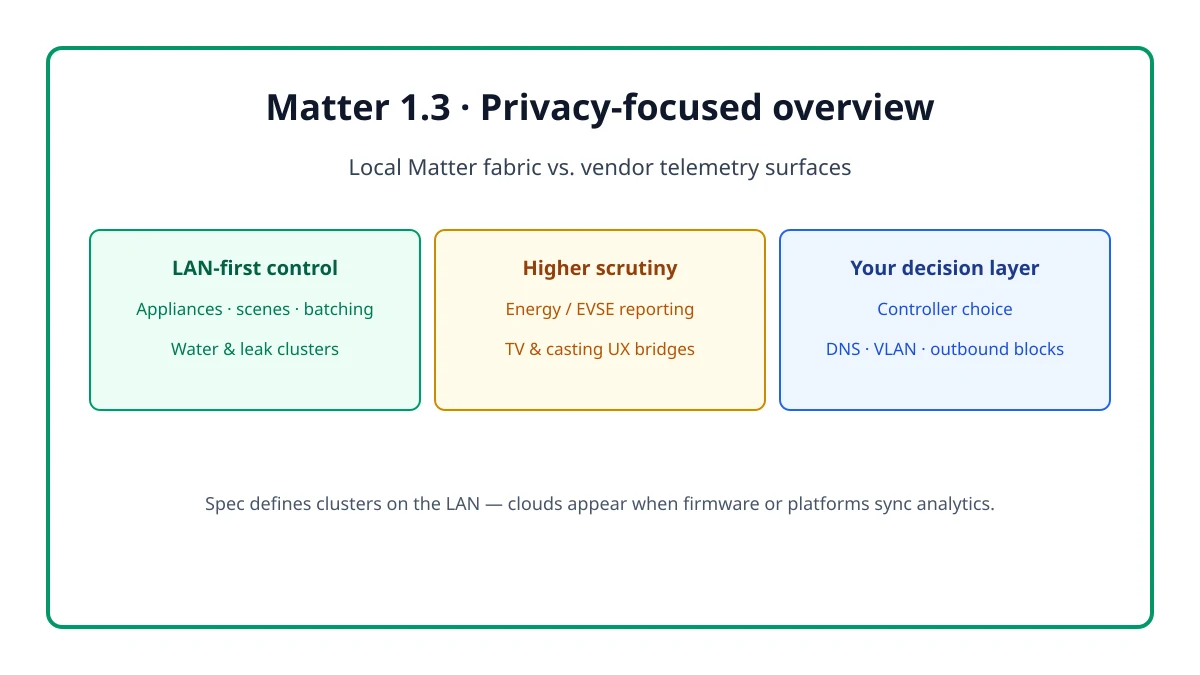
CSA Matter 1.3 defines kitchen and laundry appliances, water-management gear, EV chargers, richer TV scenarios, plus standardized energy-reporting attributes—all spoken locally between commissioners and devices on Wi‑Fi or Thread. Telemetry risk concentrates in OEM firmware, companion apps, voice assistants, grid-integration programs, and cloud-backed hubs—not in the baseline clusters themselves.
Executive Summary
Matter 1.3 is the Connectivity Standards Alliance release that formally welcomes major appliances, completes dryer coverage beside washers introduced earlier, expands energy-accounting primitives across device classes, adds structured EV charger semantics, tightens entertainment workflows for TVs and casting controllers, and improves commissioning ergonomics such as scenes and batched commands1. For privacy-focused deployments—especially Home Assistant-centric fabrics paired with segmented VLANs—the headline benefit is interoperability without surrendering router sovereignty.
Yet matter 1.3 local control is frequently misunderstood as “automatic cloud abstinence.” The specification prescribes cluster semantics on your LAN; it does not forbid vendors from embedding parallel telemetry stacks in firmware. Appliances that expose ovens or dryers through Matter often ship Wi‑Fi radios already accustomed to OEM portals. EV chargers intersect utility modernization narratives where grid signaling may bypass consumer intuition. TVs inherit advertising ecosystems whose appetite for engagement metrics dwarfs anything encoded inside Matter TLV payloads.
Bottom line: Treat Matter 1.3 as a contract for how devices converse locally, then separately audit who still ships analytics elsewhere. Pair CSA-compliant gear with controllers documented for offline resilience—see our Matter hubs: local vs cloud breakdown—and reinforce isolation using DNS filtering plus outbound firewall denies from our DNS leak playbook and IoT VLAN primer.
Privacy warning: If you commission Matter appliances inside Amazon Alexa, Google Home, or Samsung SmartThings ecosystems with mandatory vendor accounts, assume telemetry parallels Matter traffic regardless of protocol revision—because those stacks synchronize inventories and behavioral telemetry central to their business models (same hub analysis).
Matter 1.3 in Context — From Laundry Rooms to Grid-Aware Loads
CSA publicly framed Matter 1.3 around efficiency, safety, and richer automation surfaces1. Rather than reinvent physics, the standards community layered standardized clusters atop IPv6 transports already Matter-native since earlier revisions2. Understanding those pillars clarifies why appliance onboarding does not magically imply surveillance—but why electrical granularity might still tempt OEM product teams chasing usage insights.
The upgrade spans multiple simultaneous narratives:
| Theme | Representative Matter 1.3 additions | Privacy takeaway |
|---|---|---|
| Domestic chores | Microwave ovens, ovens/ranges with compartment granularity, cooktops, extractor hoods, laundry dryers paired with washers | Local scheduling reduces reliance on brittle OEM bridges but exposes granular habit timing if mirrored upstream |
| Energy literacy | Instantaneous electrical measurements plus cumulative consumption/generation reporting usable across types | Enables legitimate conservation dashboards—and precise occupancy proxies if leaked |
| Electrification | EV supply equipment semantics beyond dumb relays | Operational flexibility encourages integrations that may tunnel utility telemetry alongside Matter reads |
| Safety plumbing | Leak/freeze detectors, rain sensing, controllable valves | Alerts belong inside your perimeter—yet SMS/email relays often bounce through clouds |
| Entertainment glue | Improved casting dialogs, ambient messaging between Matter gadgets and screens | TVs become message buses; analytics risk follows screen OS vendors, not CSA text |
| Interaction polish | Standardized scenes and command batching | Reduces Wi‑Fi chatter; tangential to privacy but aids low-latency local automations |
That table underscores a pattern: each user-visible win can be mirrored as a monetizable telemetry channel if firmware chooses to. Matter merely aligns payloads—think structured measurements instead of undocumented proprietary scraping—without policing economics elsewhere.
Where Matter Keeps Traffic Local — Transport and Fabric Basics
Before dissecting appliance clusters, reaffirm how Matter preserves locality when deployed conscientiously:
- Commissioning establishes cryptographic identities binding accessories to controllers across IPv6-capable transports—Ethernet where present, predominantly Wi‑Fi for mains-powered goods, Thread for sleepy sensors2.
- Operational messaging stays on-path within multicast/subscribed scopes unless administrators deliberately bridge outward via companion clouds—often invisible behind glossy UX flows (hub-dependent leakage patterns).
- Multiple simultaneous fabrics (“multi-admin”) enable pairing one dryer into Apple Home while simultaneously enrolling it into Home Assistant—but each enrollment inherits policies from its owning ecosystem3.
Readers migrating cross-protocol meshes should revisit our protocol contrast guide covering Zigbee-to-Matter coexistence stresses.
Critically, Matter documents improvements such as Wi‑Fi directed-scan mandates for onboarding resilience1. Better commissioning lowers frustration—but does not inherently weaken LAN containment.
Companion Apps, Certificates, and the Parallel Telemetry Plane
Understanding matter 1.3 local control requires separating three stacked planes:
- Spec-grade clusters exchanged between commissioners and endpoints inside your trusted LAN boundaries.
- Operating-system services on appliances—often hardened Linux/Android derivatives—that poll OEM backends for recall notices, DRM-like accessory catalogs, or warranty telemetry unrelated to Matter TLV payloads.
- Smartphone companions that tunnel provisioning QR codes, swap firmware images, or synchronize “insights” dashboards backed by hosted analytics pipelines.
CSA conformance validates interoperability of the first plane2. It does not certify absence of the second or third—which is precisely why privacy reviewers chronically disagree with glossy retail boxes proclaiming “works locally.” Retail narratives collapse operational subtleties such as deferred TLS uploads triggered nightly when households sleep.
Major appliance OEMs routinely reuse identical connectivity modules across Wi‑Fi SKUs spanning regions with divergent RF laws. Firmware packs therefore bundle multilingual consent flows plus dormant hooks awaiting activation via remote feature flags—behavior opaque during showroom commissioning yet glaring once PCAPs expose beacon bursts toward unfamiliar Akamai fronts.
Mitigations rarely involve rejecting Matter outright; instead they orchestrate posture:
| Parallel plane | Representative artifacts | Practical containment moves |
|---|---|---|
| Matter operational plane | Subscribe interactions, scenes, batched writes | Mirror subscriptions exclusively inside trusted commissioners such as Home Assistant fabrics paired with documented offline behaviors discussed in our hub comparison. |
| Appliance OS telemetry | Crash dumps, proprietary MQTT shadows | Maintain outbound denies except narrowly scoped firmware CDN endpoints on schedules you control; archive PCAP evidence before and after upgrades. |
| Companion cloud UX | Recipe integrations, grocery QR scanners | Prefer commissioning flows that conclude entirely inside LAN-bound tooling; uninstall OEM apps once provisioning completes when regulations permit. |
Documented VLAN layouts remain foundational—especially when refrigerators coexist with workstations needing uninterrupted SaaS sessions (segmentation primer).
Finally, Matter’s cryptographic commissioning certificates anchor trust locally: compromising vendor PKI unrelated to CSA roots does not magically degrade Matter fabrics unless OEMs intentionally collapse stacks—a reminder that supply-chain audits extend beyond CSA specification downloads2.
Appliance Categories — Offline Practicality vs OEM Firmware Reality
Large appliances historically shipped Android-derived stacks notorious for dormant outbound TLS sessions. Matter alone cannot unwind those histories; it introduces standardized clusters describing microwave timers, oven cavity modes, dryer cycles, hood lamps/filters, etc1.
Evaluate offline viability across four axes:
| Appliance bucket | Typical radio mix | Offline viability signals | Telemetry flashpoints |
|---|---|---|---|
| Microwave ovens | Wi‑Fi | Strong local UX once commissioned | Companion recipes / scanning packaged foods via OEM clouds |
| Full ovens / ranges | Wi‑Fi | Mixed—vendor safety locks may block remote start under regulation | Firmware bundles tying warranties to portal telemetry |
| Cooktops | Wi‑Fi | Remote heat adjustments sometimes constrained regionally | OEM analytics correlating meals with identities |
| Hoods | Wi‑Fi | Usually benign commands | Filter lifecycle reminders routed via vendor messaging gateways |
| Laundry dryers | Wi‑Fi | Completes pairing with washers—often automation-heavy | Cycle telemetry exposing occupancy rhythms |
CSA enumerates notifications such as “end of cycle,” door-state cues, oven preheat milestones, or lint reminders1. Those signals empower deterministic scenes inside Home Assistant Node-RED flows—ideal when blocking WAN egress—because HA treats Matter subscriptions as LAN-local callbacks without mandated vendor relays when your deployment avoids hybrid assistants—compare ecosystems in our Matter hub privacy breakdown.
Nevertheless, OEM UX frequently insists on proprietary hygiene reminders (“Replace HEPA charcoal insert SKU …”) linking mobile apps dependent on Firebase analytics or aggressive CDN manifests. Segment appliance VLANs tightly—mirroring lessons from our IoT VLAN primer—and inspect DHCP vendor-class identifiers before trusting isolation.
Energy Reporting — Blessing for Bills, Hazard for Fingerprints
Energy-management enhancements headline CSA outreach because climate narratives emphasize measurable conservation1. The Alliance explicitly noted instantaneous measurements plus aggregated consumption/generation windows spanning arbitrary device archetypes—not solely chargers1.
Why privacy nerds care:
- Temporal granularity exposes appliance sequencing—dryers followed by charging EVs betray household chore rotations or commuting rhythms.
- Voltage/current harmonics sometimes correlate heavy machinery fingerprints usable even without naming devices outright.
- Normalization across Matter fabrics simplifies dashboards—but duplicates telemetry streams vendors previously scraped imperviously via undisclosed MQTT feeds.
Treat Matter-native readings like structured syslog equivalents: indispensable locally, perilous once mirrored externally without contractual safeguards.
Electric Vehicle Supply Equipment (EVSE)
Matter EVSE semantics emphasize flexible scheduling blocks—manual overrides, adjustable charging rates, departure-centric optimizations marketed toward shifting loads away from peak tariffs1. Nothing here mandates utility surveillance.
Outside CSA prose, OEM commercial decks routinely tout grid collaborations; CSA itself highlighted liaison momentum across ecosystem foundations4. Assume chargers ship hybrid stacks:
| Deployment stance | Operational upside | Telemetry posture |
|---|---|---|
| Strict LAN-only commissioning | Predictable Matter-local scheduling inside HA energy dashboards | Requires disabling OEM LTE/Wi‑Fi modem uplinks where hardware permits |
| Vendor-managed eco tariffs | Automated tariff chasing | Vendor APIs consolidate charging curves correlated with accounts |
| Utility demand-response enrollment | Potential rebates | Telemetry exchanged outside Matter fabrics entirely |
CSA’s broader alliance roadmap explicitly acknowledges tighter coupling between consumer devices and grid modernization initiatives4; assume chargers marketed after 2026 increasingly expose enrollment toggles blending Matter-readable schedules with vendor-mediated cloud relays unless you intervene.
Segment chargers onto IoT VLANs with denied WAN defaults while documenting deliberate exceptions—perhaps OT firmware downloads scheduled quarterly—to mimic workflows outlined for broader DNS leak mitigation.
Water Management — Local Alerts vs Notification Relay Habits
Leak detectors, freeze sensors, rain gauges, and automated valves arguably yield the strongest privacy ROI among Matter 1.3 introductions because catastrophic failures outweigh incremental advertisement revenue1. Matter framing emphasizes actionable homeowner alerts rather than monetizable behavioral surplus.
Yet SMS gateways or OEM notification relays routinely traverse Twilio-grade endpoints—outside Matter semantics—meaning isolation reviewers must observe DNS queries triggered during simulated floods. Combine Matter subscriptions with redundant local sirens when feasible.
Entertainment Surfaces — TVs as Busy Intersections
CSA promoted richer interplay between Matter-controlled gadgets and televisions—ambient dialogs, appliance notifications surfaced on panels, casting handshake polish1. Privacy framing differs from ovens:
| Capability | Local advantage | Telemetry amplification risk |
|---|---|---|
| Appliance→TV alerts | Household glanceability without grabbing phones | Smart TV OS vendors monetize impressions aggressively |
| Expanded casting UX | Fewer interoperability hacks | Logs correlate playback telemetry across ecosystems |
| Scene interoperability via Matter scenes | Reduced popcorn latency across bridged Zigbee bulbs | Minimal alone—but merges households under unified advertiser graphs |
Assume televisions remain dual-homed: Matter commissioner endpoints alongside HDMI streaming stacks leaking viewing telemetry irrespective of CSA diligence—see why bridging stacks still tempt OEM dependency loops in our Matter hubs companion guide.
Mitigations remain mundane—hardwired DHCP reservations, VLAN egress denies for analytics endpoints documented in DNS leak remediation, Pi-hole-style RPZ—but Matter readers must resist believing CSA expansions sanitize Samsung Tizen or Google TV telemetry appetites.
Commissioning Improvements That Quietly Aid Offline Households
Several Matter 1.3 refinements indirectly reinforce offline resilience1:
- Directed Wi‑Fi scans shrink flaky onboarding loops—fewer frustrated users punching holes through firewall zones temporarily “just to finish pairing.”
- Network commissioning clusters exposing Thread revisions clarify transport debugging—critical when diagnosing half-working Thread meshes spanning appliance-heavy shelves2.
- Command batching reduces chatter across bridges—particularly when synchronizing blinds, lights, and hoods executing cook-mode scenes simultaneously.
While not privacy features per se, they lower the temptation to temporarily allow wide-open WAN access during troubleshooting—an overlooked social engineering vector in many homes.
Extended beaconing windows further widen commissioning tolerance—comfortable for retrofit installers juggling breaker panels—but keep radios observable longer during pairing storms; monitor rogue BLE/Wi‑Fi observers accordingly1.
Scenes, Batching, and the Discipline of Local-First Automations
Standardized scenes store multi-device targets on participants, shrinking per-transition command fan-out1. For Home Assistant adopters, scenes become exportable canon without cloud scene stores—provided you avoid assistants that secretly upload scene graphs for “convenience.”
Practical workflow:
- Model automations declaratively inside HA YAML or UI with version control.
- Mirror only the minimum attribute set Matter requires—no extraneous vendor extensions.
- Document multi-fabric pairing so guests’ platforms do not unintentionally widen blast radius relative to controllers outlined in our hub comparison.
Cross-link reminder: bridging too many commissioners reintroduces identity sprawl—CSA publicly emphasizes Matter’s promise for simplified onboarding across ecosystems3, yet multi-admin convenience trades away deterministic perimeter clarity unless you gate pairing ceremonies meticulously (transport contrast).
Verification Playbook — Turning Spec Knowledge into Evidence
Knowledge without measurement stays hypothetical. Combine CSA literacy with empirical rigor:
| Verification step | Tooling hints | Interpretation |
|---|---|---|
| Baseline WAN denies | Stateful firewall logs + IDS alerts | Unexpected bursts during idle ovens imply rogue telemetry |
| DNS telemetry | Recursive resolver query logs tied to DoT/DoH policies | Look for obscure telemetry domains bypassing resolver-enforced RPZ lists |
| VLAN containment tests | Mirror ports or SPAN toward Zeek/Suricata | Validate Matter multicast confinement vs misrouted IGMP |
| Hub swap experiment | Parallel Home Assistant vs cloud hub | Demonstrates identical device behavior diverging only in uplink chatter |
| Controlled outage drill | WAN kill switch nightly | Appliances should maintain last scenes if truly local |
| mDNS reflection audit | Avahi/Bonjour gateways | Rogue reflection across VLANs leaks device inventories described when contrasting transports (protocol mesh primer) |
Document results per device class; future you inherits defensible audits when guests ask “Is this stove spying?”
CSA maintains public directories enumerating certified endpoints versus evolving SDK revisions3. Certification validates interoperability sessions—not absence of dormant LTE paths—so treat badges as helpful guardrails rather than unconditional privacy proofs.
Checklist
- Read the CSA Matter 1.3 announcement alongside this guide to align marketing language with engineering scope.
- Pair new appliances with a controller that documents offline resilience—often Home Assistant or Apple Home depending on tolerance for iCloud semantics.
- Place ovens, dryers, hoods, and EV chargers on dedicated IoT VLANs with deny-by-default WAN policies and intentional exceptions.
- Mirror Matter energy readings locally first (SQLite/Influx inside HA) before trusting OEM dashboards promising carbon insights.
- Expose televisions only to Matter commissioners that skip cloud scene sync when possible; block TV analytics domains aggressively.
- For EVSE, inventory whether cellular modems exist; disconnect or cage them if tariffs do not legally require persistent uplink.
- Re-run DNS and firewall audits after firmware updates—OEMs occasionally enable “experience improvement” toggles silently.
- Correlate Matter device types with CSA certification metadata to detect pre-1.3 firmware masquerading as feature-complete appliances.
FAQ
Frequently Asked Questions
Does Matter 1.3 mean my microwave and dryer always work offline after setup?
The Matter specification defines local IPv6/Wi‑Fi or Thread interactions on your LAN; nothing in the spec mandates an internet uplink for routine device commands. Whether your appliance stays usable offline depends on the manufacturer firmware, mandatory OEM accounts, safety locks, and the hub you pair it with—not on the CSA baseline alone.
Is Matter 1.3 energy reporting inherently a telemetry leak?
Energy measurements are modeled so controllers can read power, voltage, current, and similar quantities locally. Those readings become a privacy risk only if firmware or companion apps aggregate them into analytics or sync them to vendor clouds. Treat granular load signatures like behavioral data and segment or block outbound paths accordingly.
Can Matter EV chargers stay cloud-free while still being useful?
Matter EVSE features described by CSA focus on consumer-visible charging controls such as start/stop, rate adjustments, and departure-time-oriented scheduling within the home stack. Utilities or vendors may still layer grid programs or proprietary dashboards that phone home; assume hybrid designs until you inspect traffic from your VLAN.
Do TVs and Matter casting improvements force vendor telemetry?
Matter 1.3 expands TV-oriented scenarios such as richer casting dialogs, notifications from other devices, and interactions between appliances and screens. Those UX bridges make televisions more attractive aggregation points for OEM analytics or advertising stacks even though Matter frames themselves traverse local networks between participating nodes.
Which Matter 1.3 clusters deserve firewall scrutiny first?
Prioritize outbound monitoring on appliance firmware that bundles optional cloud scenes, firmware vendors tied to recurring subscriptions, EVSE vendors participating in grid demand-response partnerships, and entertainment devices that mix Matter control channels with streaming platforms sharing tracking IDs.
How does Matter 1.3 relate to Thread for appliance deployments?
Matter rides above IPv6 transports including Ethernet, Wi‑Fi, and Thread. Low-power sensors often use Thread border routers; large appliances usually appear on Wi‑Fi. Either transport keeps Matter frames local inside your home, but Wi‑Fi appliances frequently coexist with legacy cloud stacks—raising DNS, TLS, and OEM portal exposure compared with simpler Thread gadgets.
Primary Sources Table
| ID | Title / Description | Direct URL |
|---|---|---|
| [1] | CSA newsroom — Matter 1.3 specification released | https://csa-iot.org/newsroom/matter-1-3-specification-released/ |
| [2] | CSA Matter specification downloads | https://csa-iot.org/developer-resource/specifications-download-request/ |
| [3] | CSA Matter fundamentals overview | https://csa-iot.org/all-solutions/matter/ |
| [4] | CSA × OpenADR liaison announcement | https://csa-iot.org/newsroom/connectivity-standards-alliance-and-openadr-alliance-announce-liaison-agreement-to-collaborate-on-grid-connected-energy-management/ |
| [5] | Matter vs Zigbee vs Z-Wave vs Thread comparison (Privacy Smart Home) | /guides/matter-vs-zigbee-vs-z-wave-vs-thread-complete-comparison-2026/ |
| [6] | IoT VLAN setup primer | /guides/iot-vlan-setup-for-beginners-smart-home-privacy-2026/ |
| [7] | Blocking IoT DNS leaks | /guides/how-to-block-iot-dns-leaks-doh-dot-hardcoded-dns-2026/ |
| [8] | Matter hubs — local vs cloud | /guides/matter-smart-home-hubs-local-vs-cloud-which-is-better-for-privacy-2026/ |
| [9] | Matter devices that still require hubs | /guides/matter-devices-that-still-require-hubs-2026/ |
Conclusion
Matter 1.3 advances matter 1.3 local control where it matters operationally: standardized semantics for appliances, granular electrical telemetry, structured EV charger workflows, resilient commissioning polish, and richer TV-mediated orchestration—all traversing IPv6 transports documented by CSA12. CSA documentation stops at interoperability—fair enough—while privacy practitioners must pursue complementary hygiene: controllers without mandatory uplinks (hub comparison), VLAN segmentation (primer), resolver telemetry scrutiny (DNS playbook), and skeptical readings of OEM privacy policies.
Keep pressure on vendors to disclose what leaves the LAN—even when Matter frames never do—and favor hardware that exposes open local APIs without dark-pattern account holds. Future revisions will continue expanding device classes, but your threat model stays rooted in controllers, radios, and economics outside any single CSA press release.
Footnotes
-
CSA newsroom — Matter 1.3 specification released — https://csa-iot.org/newsroom/matter-1-3-specification-released/ ↩ ↩2 ↩3 ↩4 ↩5 ↩6 ↩7 ↩8 ↩9 ↩10 ↩11 ↩12 ↩13 ↩14
-
CSA Matter specification downloads — https://csa-iot.org/developer-resource/specifications-download-request/ ↩ ↩2 ↩3 ↩4 ↩5 ↩6
-
CSA Matter fundamentals overview — https://csa-iot.org/all-solutions/matter/ ↩ ↩2 ↩3
-
CSA × OpenADR liaison — https://csa-iot.org/newsroom/connectivity-standards-alliance-and-openadr-alliance-announce-liaison-agreement-to-collaborate-on-grid-connected-energy-management/ ↩ ↩2