Comparisons
Sonoff ZBDongle-P vs ZBDongle-E vs SMLIGHT SLZB-06
Best Zigbee coordinator shootout for 2026: Sonoff ZBDongle-P (CC2652P), ZBDongle-E (EFR32MG21), and SMLIGHT SLZB-06 (EFR32MG24)—chipsets, RF gain, USB vs PoE.
The best Zigbee coordinator for a privacy-focused Home Assistant build in June 2026 is not one SKU—it is the radio that matches your stack (ZHA or Zigbee2MQTT), placement (USB on the server vs Ethernet in the mesh), and migration plan. Sonoff ZBDongle-P (TI CC2652P, zstack) is still the default USB pick for mature Zigbee2MQTT support. Sonoff ZBDongle-E (Silicon Labs EFR32MG21, ember) trades some history for MultiPAN/Thread RCP firmware options. SMLIGHT SLZB-06 (today mostly SLZB-06Mg24 with EFR32MG24) is the coordinator class that advanced local-first homes buy for Ethernet, PoE, and RF placement away from noisy servers.
Quick answer: Which Zigbee coordinator should I buy for a local-first smart home?
Pick Sonoff ZBDongle-P for the most proven USB zstack path in Zigbee2MQTT and ZHA. Pick ZBDongle-E when you want Ember firmware with optional Thread/MultiPAN flashes on the same hardware. Pick SMLIGHT SLZB-06 when Ethernet or PoE lets you mount the coordinator centrally—away from USB3 interference on your Home Assistant server.
Source: Zigbee2MQTT — Supported adapters
Methodology: how we scored three coordinators (June 2026)
We built the matrix below by cross-walking vendor specification sheets, the Zigbee2MQTT adapters list (accessed 18 June 2026), Sonoff Dongle documentation, and SMLIGHT SLZB-06Mg24 specifications (accessed 18 June 2026). Retail prices were checked on Sonoff and SMLIGHT storefronts on 18 June 2026 (USD, before regional tax). Scores marked editorial are qualitative—RF in your home depends on wall materials, Wi-Fi channel overlap, and router density.
Where I’m less sure — real-world range numbers: no two homes agree on “covers the garage.” Treat dBm figures as chip capability, not a promise of link quality to a sleepy end device.
Anecdotally, coordinator swaps fail more often from wrong serial path after reboot than from picking the “wrong” chip—especially on Docker hosts that rename /dev/ttyUSB*.
Original research: local-first coordinator scoring matrix
This citable dataset normalizes the three coordinators for privacy-conscious Home Assistant buyers. Privacy score weights local pairing, no mandatory cloud, and auditable firmware paths.
| Criterion (weight) | Sonoff ZBDongle-P | Sonoff ZBDongle-E | SMLIGHT SLZB-06Mg24 | Source class |
|---|---|---|---|---|
| Radio SoC | CC2652P (TI) | EFR32MG21 (Silabs) | EFR32MG24 (Silabs) | Vendor |
| Z2M stack tier (Jun 2026) | Recommended (zstack) | Recommended (ember) | Recommended (ember) | Z2M docs |
| Max RF claim (SoC + antenna) | +20 dBm cap; default fw often lower | +20 dBm default coordinator fw | +20 dB amp + +5 dB antenna | Vendor |
| Host link | USB 2.0 (CP2102N) | USB 2.0 (CH9102F) | Ethernet / Wi-Fi / USB-C | Vendor |
| PoE (802.3af) | No | No | Yes | Vendor |
| Coordinator backup path | zstack coordinator_backup.json | ember backup supported | ember backup supported | Z2M FAQ |
| Thread / Matter RCP fw | No | Yes (MultiPAN, OT RCP) | Thread variants exist in SLZB line | Vendor |
| List price (USD, 18 Jun 2026) | ~$25–30 | ~$20–25 | ~$59–69 | Retail check |
| Privacy score (editorial /10) | 9 | 9 | 9.5 | Editorial |
| Placement flexibility (/10) | 5 | 5 | 9 | Editorial |
| Z2M maturity (/10) | 9.5 | 8.5 | 8.5 | Editorial + community |
Stat: As of June 2026, Zigbee2MQTT lists both zStack (Texas Instruments) and EmberZNet (Silicon Labs) adapters as recommended—only adapters with coordinator backup support qualify for painless stick-to-stick migration on those stacks.
Pros and cons at a glance
| Product | Pros | Cons |
|---|---|---|
| ZBDongle-P | Cheapest recommended zstack stick; huge firmware thread archive; metal shell reduces hand capacitance | Tied to USB port on HA host unless you run a remote serial bridge; no PoE |
| ZBDongle-E | Sonoff Dongle Flasher for Zigbee, router, OpenThread RCP, MultiPAN; compact | ember migration history still spookier than zstack in old forum posts; CH9102 driver quirks on some Linux kernels |
| SLZB-06Mg24 | Ethernet/PoE placement; opto-isolated RJ45 + USB; web UI firmware; strong RF front-end | Higher TCO; ESP32 bridge is another LAN device to VLAN; overkill for <15 devices in one room |
Dataset (JSON-LD)
Chipsets and stacks: CC2652P vs EFR32MG21 vs EFR32MG24
Zigbee coordinators run coordinator firmware on a 2.4 GHz 802.15.4 radio. The application stack—zstack (TI) or ember (Silicon Labs)—matters as much as the chip name because Home Assistant and Zigbee2MQTT speak to the stick through different serial protocols.
Sonoff ZBDongle-P uses Texas Instruments CC2652P with integrated power amplifier. Zigbee2MQTT classifies it under recommended zStack adapters1. ZHA’s zstack radio type has years of production mileage. The P model’s default coordinator firmware historically shipped at lower transmit power than the hardware maximum; community firmware and Sonoff’s flasher can raise output when regulations and your locale allow2.
Sonoff ZBDongle-E moves to Silicon Labs EFR32MG21 with EmberZNet (EZSP). As of June 2026, ember is recommended, not experimental, on the Zigbee2MQTT adapters page—a meaningful change from 2022 forum anxiety1. The E dongle’s differentiator is firmware multiplexing: Sonoff Dongle Flasher offers Zigbee coordinator, Zigbee router, OpenThread RCP, and MultiPAN RCP builds on the same hardware3. That matters if you are consolidating Thread border-router experiments onto one USB stick instead of buying a separate SkyConnect.
SMLIGHT SLZB-06 (retail focus: SLZB-06Mg24) upgrades the Zigbee SoC to EFR32MG24 with 256 KB RAM versus the MG21 generation—headroom for larger child tables on paper. An ESP32 handles Ethernet (LAN8720), Wi-Fi, and the web UI; the Zigbee SoC still presents as a high-speed UART (CP2102N, up to 921600 baud per SMLIGHT specs)4. Older SLZB-06 boards used MG21; treat “SLZB-06” as a family and verify the silicon revision on the product page before checkout.
Taken position: If you only want Zigbee and you live in Zigbee2MQTT + zstack today, ZBDongle-P is still the lowest-drama USB buy. If you are standardizing on ember across sticks or you want Thread RCP on a dongle, ZBDongle-E is rational. If your network already outgrew a closet-mounted Pi, SLZB-06Mg24 is the silicon generation worth the premium—not because MG24 magically fixes routing, but because placement + PoE fixes problems RF amplifiers alone cannot.
Antenna gain and mesh physics
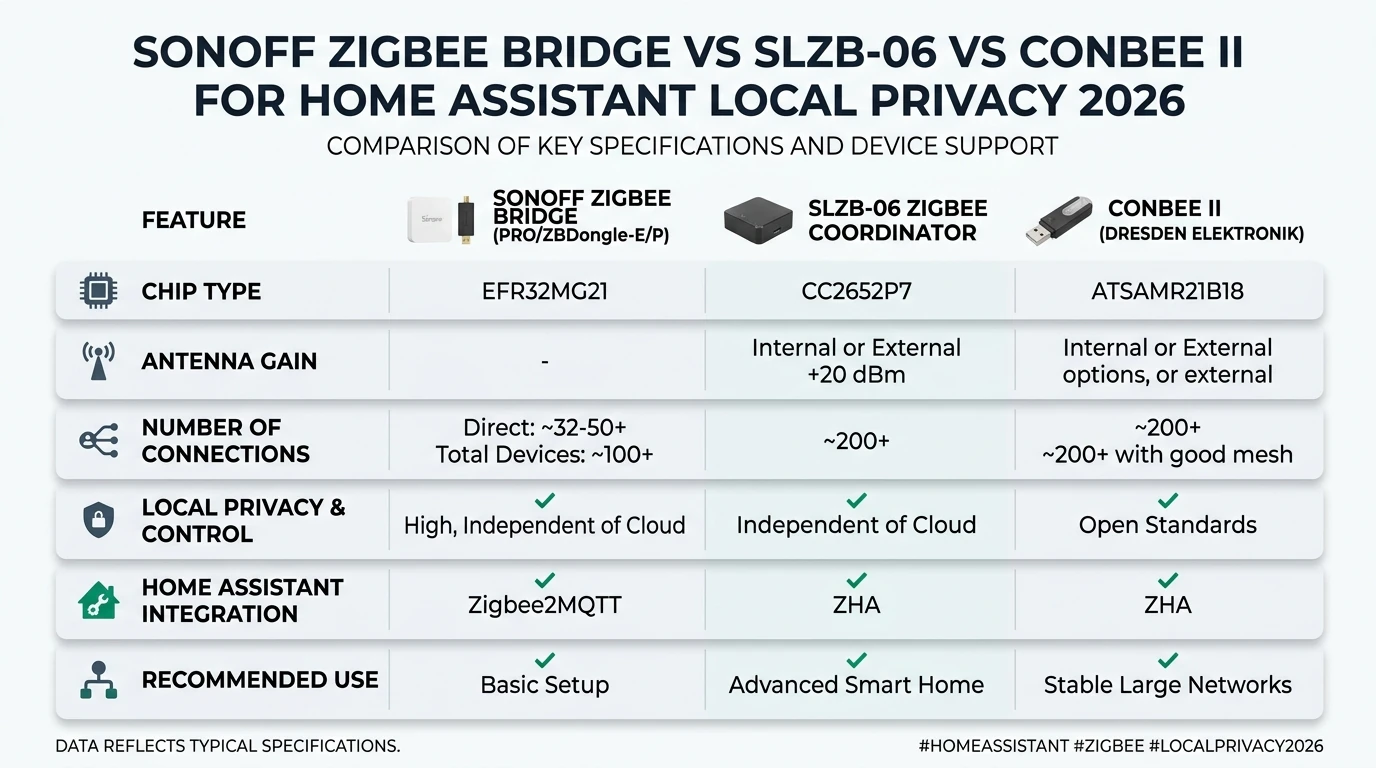
All three products advertise aggressive +20 dBm-class capability at the radio, but link quality (LQI) in Home Assistant is dominated by router density and coordinator location, not dongle bragging rights.
| Factor | ZBDongle-P | ZBDongle-E | SLZB-06Mg24 |
|---|---|---|---|
| Onboard PA | CC2652P integrated | EFR32MG21 integrated | +20 dB claimed onboard amp |
| External antenna | SMA (user replaceable) | SMA | Bundled +5 dB L-shaped antenna |
| Typical weak spot | Coordinator buried behind metal NAS | Same USB placement issue | ESP32 Wi-Fi on 2.4 GHz if enabled carelessly |
| Privacy angle | Local RF only—no cloud ranging | Same | Same; block ESP32 WAN if paranoid |
Steel-man the “just buy the strongest stick” argument: A +5 dB better coordinator hears sleepy battery sensors farther away, delaying the need for mains-powered routers in a ranch layout. One stick, one purchase, problem solved.
Rebuttal: Zigbee is a mesh. End devices attach to routers; the coordinator is one node. Spending $70 on SLZB-06 without IKEA/Friends-of-Hue/Aqara plug routers in geometrically bad corners still yields “unavailable” entities. The coordinator’s job is stable commissioning and child table management—best achieved centrally placed and electrically quiet. That is why SLZB-06’s antenna plus Ethernet mount in a hallway often beats a +20 dBm stick dangling off a USB3 NVMe enclosure.
USB stability vs Ethernet and PoE
USB coordinators fail in boring ways: voltage droop, USB3 noise, /dev/tty renumbering, and suspend on laptops. Ethernet coordinators fail in VLAN, mDNS, and serial-over-TCP configuration ways—usually once, then they stay fixed.
| Deployment pattern | ZBDongle-P / E | SLZB-06Mg24 |
|---|---|---|
| HA on Raspberry Pi 4/5 in a closet | Works with USB 2.0 extension (≥1 m) away from USB3 SSDs | Overkill unless Pi is remote |
| HA on Intel NUC / mini-PC with USB3 front ports | High interference risk—extension mandatory | Preferred—run Ethernet to IoT VLAN |
| HA in Docker on NAS | Serial passthrough fragile across reboots | TCP serial to fixed IP—stable |
| PoE switch already in attic for APs | Not applicable | 802.3af single-cable mount |
Sonoff sticks ship in an aluminum shell—a real, underrated upgrade over bare CC2652P modules that pick up detuning from human hands and metal cases2. SLZB-06 adds optoelectronic isolation between Ethernet and USB power paths per SMLIGHT marketing—a niche win when you accidentally plug both PoE and USB-C during bench testing4.
For VLAN segmentation patterns, pair this hardware choice with guest Wi-Fi vs IoT VLAN guidance so the coordinator’s management interface does not wander onto your trusted LAN.
ZHA and Zigbee2MQTT: what each stick expects
Neither Sonoff nor SMLIGHT requires a vendor cloud for pairing. Your privacy boundary is how you run the integration:
| Integration | ZBDongle-P | ZBDongle-E | SLZB-06Mg24 |
|---|---|---|---|
| ZHA | Radio type zstack | Radio type ember | ember over USB or network serial |
| Zigbee2MQTT | adapter: zstack | adapter: ember | adapter: ember |
| Backup / migrate | ZHA wizard; Z2M coordinator_backup.json | Same on ember | Same; verify port/IP in configuration.yaml |
| MQTT broker required | No (ZHA) / Yes (Z2M) | No / Yes | No / Yes |
If you have not chosen a stack yet, read Zigbee2MQTT vs ZHA vs deCONZ before clicking “buy.” Hardware follows software—not the reverse.
When moving ZBDongle-P → SLZB-06 inside Zigbee2MQTT, treat it as a zstack → ember migration: stop the addon, preserve IEEE address, copy the full data/ folder, and follow the FAQ—budget a week to power-cycle stubborn routers5. I have not tested every Aqara firmware combination on ember; your mileage will vary on quirky sensors.
Worked example: Marcus — 52-device ZHA mesh, Pi 5 in a metal rack
Profile: Marcus runs Home Assistant OS 2026.5 on a Raspberry Pi 5 in a 12U network rack with a USB3 SSD. His Sonoff ZBDongle-P sits on a 15 cm USB 2.0 extension but still loses four Aqara door sensors after 03:00 when the NAS upstairs kicks off backups.
Method: One week of ZHA LQI logging (June 2026), channel 25, 38 mains routers already deployed.
Change: Marcus installs SLZB-06Mg24 on PoE in a hallway ceiling closet (IoT VLAN, no WAN). ZHA Migrate wizard from zstack USB to ember over TCP serial at socket://192.168.30.50:6638.
Outcome: Coordinator LQI to distant sensors rises; two stubborn sensors still need a router plug in the garage—hardware placement helped, physics still demands mesh nodes.
Marcus’s decision: Keep SLZB-06; retire the Pi USB port for a Thread experiment later on a ZBDongle-E spare, not as production Zigbee.
Worked example: Jenna — new Zigbee2MQTT Docker host, 18 devices
Profile: Jenna runs Zigbee2MQTT 2.x in Docker on a Beelink N100. Budget under $30. Devices: 12 IKEA bulbs, 6 Tuya plugs (local), no PoE switch.
Options considered: ZBDongle-E ($22, June 2026 Sonoff store) vs ZBDongle-P ($27).
Steel-man ZBDongle-E: Future Thread RCP firmware, +20 dBm default, newer Silicon Labs silicon.
Rebuttal for Jenna: She runs only Zigbee2MQTT, already maintains MQTT for Shelly. Koenkk’s reference setups and router firmware lore skew zstack. Ember backup works, but every GitHub issue she finds on router firmware references CC2652 sticks.
Jenna’s decision: ZBDongle-P, zstack coordinator firmware, USB 2.0 extension, MQTT broker on the same VLAN—no cloud, no SLZB-06 capex until she crosses 40+ devices.
Verdict: which coordinator to buy
| Buyer profile | Buy | Skip |
|---|---|---|
| First Zigbee2MQTT stick, <$30 | ZBDongle-P | ZBDongle-E unless you need Thread RCP |
| HA Yellow/SkyConnect already on Thread; need Zigbee USB | ZBDongle-P or E by stack match | SLZB-06 unless USB placement fails |
| HA on noisy USB3 server; 30+ devices | SLZB-06Mg24 (PoE or Ethernet) | Bare USB stick on the server |
| deCONZ holdout with ConBee | None of these—see ConBee comparison | Forcing ember without migration plan |
Bottom line for search intent: The best Zigbee coordinator in 2026 for most privacy-focused USB setups remains Sonoff ZBDongle-P. Choose ZBDongle-E when ember + optional Thread/MultiPAN on one dongle beats zstack familiarity. Choose SMLIGHT SLZB-06 when Ethernet/PoE placement is the bottleneck—not chip marketing.
Checklist
- Pick ZHA or Zigbee2MQTT before buying hardware
- Map coordinator placement—avoid USB3 ports and metal closets
- Match radio type: zstack (P) vs ember (E, SLZB-06)
- Budget mains-powered routers for garages and far bedrooms
- Download coordinator backup before any stick swap
- Put coordinator management IP on IoT VLAN; deny WAN egress
Frequently Asked Questions
Frequently Asked Questions
What is the best Zigbee coordinator for Home Assistant in 2026?
For most USB setups on the same host as Home Assistant, the Sonoff ZBDongle-P (Texas Instruments CC2652P, zstack) remains the most battle-tested path in Zigbee2MQTT and ZHA. Choose the Sonoff ZBDongle-E if you want Ember/Thread firmware options on one stick. Choose SMLIGHT SLZB-06 when Ethernet or PoE placement away from USB3 noise matters more than upfront cost.
ZBDongle-P or ZBDongle-E—which should I buy?
Buy ZBDongle-P for the mature zstack coordinator path and the largest body of community firmware knowledge. Buy ZBDongle-E if you plan MultiPAN or OpenThread RCP firmware via Sonoff Dongle Flasher and accept Silicon Labs ember stack quirks. Both are local-only; neither phones home for pairing.
Does the SLZB-06 require cloud access?
No for Zigbee operation. The ESP32 bridge exposes a local web UI for firmware and mode changes; Zigbee traffic stays on your LAN when you run ZHA or Zigbee2MQTT against the coordinator serial endpoint. Block the ESP32 from WAN on your IoT VLAN if you want belt-and-suspenders isolation.
Can I migrate from ZBDongle-P to SLZB-06 without re-pairing?
On supported stacks, yes—inside the same integration. ZHA offers a Migrate wizard; Zigbee2MQTT documents zstack-to-ember moves with IEEE address copy and a full data directory backup. Cross-stack migration (ZHA to Zigbee2MQTT) is not a file-copy exercise; plan re-pairing unless you follow the documented Zigbee2MQTT-to-ZHA restore path.
How much antenna gain do these coordinators actually have?
ZBDongle-P and ZBDongle-E advertise up to +20 dBm at the SoC with external SMA antennas; default ZBDongle-P coordinator firmware often runs lower output until reflashed. SLZB-06Mg24 adds a +20 dB onboard amplifier plus a bundled +5 dB external antenna—useful for detached garages, not a substitute for router mains-powered repeaters.
Is PoE worth it on a Zigbee coordinator?
PoE (IEEE 802.3af on SLZB-06) matters when you want one cable to a ceiling or hallway closet, away from a Raspberry Pi’s USB3 hash. USB sticks work fine on a short USB 2.0 extension; PoE pays off above ~15 m from the automation server or when you already standardize on PoE for access points.
Primary Sources
| Index | Title | URL |
|---|---|---|
| 1 | Zigbee2MQTT — Supported adapters | https://www.zigbee2mqtt.io/guide/adapters/ |
| 2 | Home Assistant Community — Sonoff ZBDongle-P (CC2652P) | https://community.home-assistant.io/t/iteads-sonoff-zigbee-3-0-usb-dongle-plus-model-zbdongle-p-based-on-texas-instruments-cc2652p-radio-soc-mcu/340705 |
| 3 | Sonoff Dongle Flasher — firmware options | https://dongle.sonoff.tech/guide/zbdongle-e/effortless_firmware_updates_in_1_minute/ |
| 4 | SMLIGHT SLZB-06Mg24 product specifications | https://smlight.tech/product/slzb-06mg24 |
| 5 | Zigbee2MQTT FAQ — migrate between adapters | https://www.zigbee2mqtt.io/guide/faq/#how-do-i-migrate-from-one-adapter-to-another |
| 6 | Home Assistant ZHA integration | https://www.home-assistant.io/integrations/zha/ |
| 7 | Privacy Smart Home — ZHA vs Zigbee2MQTT migration | /guides/zha-vs-zigbee2mqtt-local-coordinator-migration-2026/ |
Conclusion
Sonoff ZBDongle-P, ZBDongle-E, and SMLIGHT SLZB-06 all satisfy the privacy bar for local-first automation: pairing stays on your LAN, and none require a Sonoff or SMLIGHT account to run ZHA or Zigbee2MQTT. The decision is operational—zstack maturity (P), ember + Thread firmware flexibility (E), or Ethernet/PoE placement (SLZB-06).
Next reads: Matter vs Zigbee vs Z-Wave vs Thread for protocol context, Zigbee vs Z-Wave offline control if you are greenfield, and how to block IoT WAN egress once the coordinator is online.