Smart Home Privacy
Nest vs Ecobee vs Honeywell: Privacy & Control 2026
Nest Learning vs Ecobee Premium vs Honeywell T6 for privacy in 2026: Google cloud depth, Ecobee account telemetry, and Z-Wave local HVAC control trade-offs.
Quick answer: Which smart thermostat is most private in 2026: Nest, Ecobee, or Honeywell?
Honeywell T6 Pro Z-Wave (or T10 with a local-focused hub) keeps HVAC control on your LAN when paired with Home Assistant or a Z-Wave hub. Nest is the most Google-tied. Ecobee sits in the middle—disable cloud extras and prefer HomeKit or HA integrations for fewer vendor dashboards.
Executive Summary
In 2026, choosing a smart thermostat involves balancing privacy concerns, local control capabilities, and total cost of ownership (TCO). This guide compares the Nest Learning Thermostat (4th Gen), Ecobee Smart Thermostat Premium, and Honeywell T6/T10. Extend the topic with best thermostats without cloud, smart home energy monitors, and Matter hub privacy.
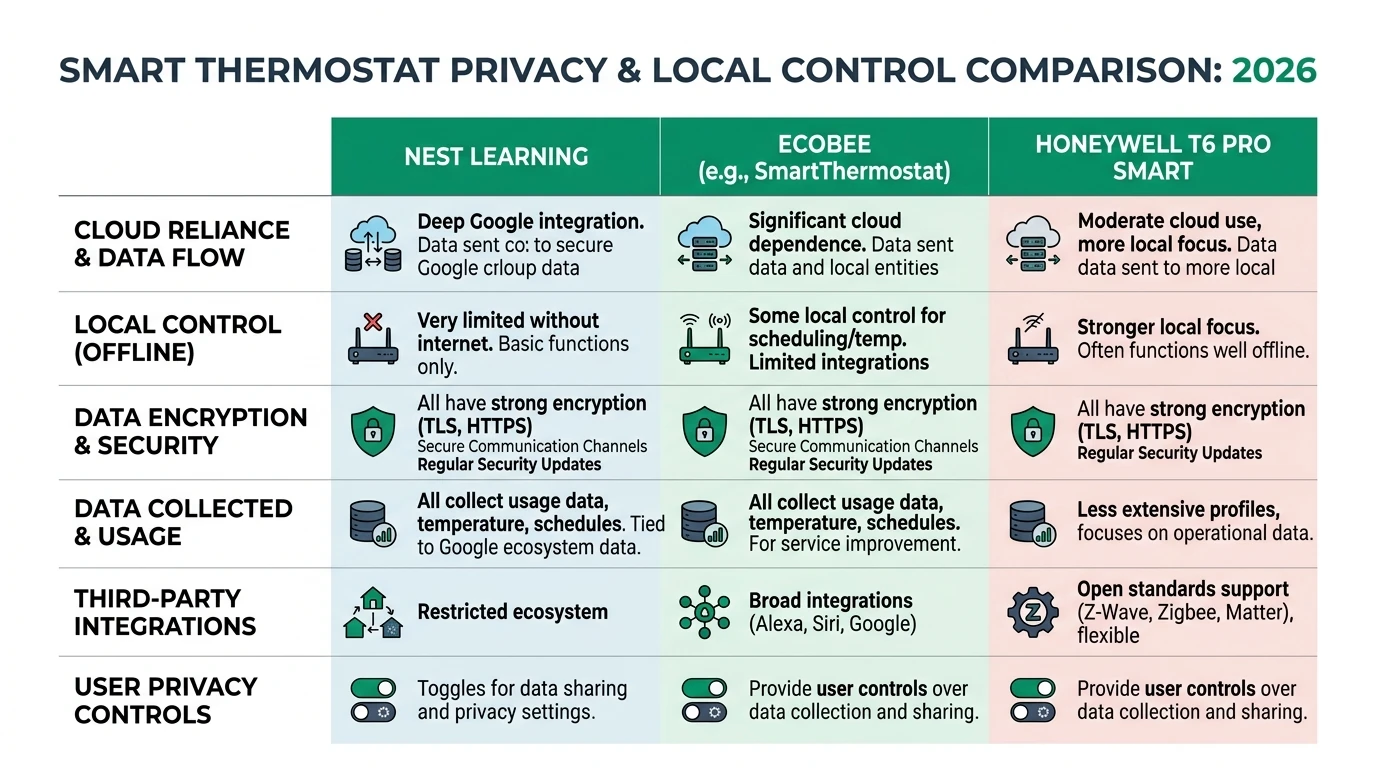
The Nest Learning Thermostat, deeply integrated with Google’s ecosystem, offers extensive smart features but relies heavily on cloud services, raising privacy concerns. Ecobee’s Premium model balances smart home integration with some local processing, though it still shares data with third-party services. Honeywell’s T6/T10 stands out for its strong local control via RedLINK technology, offering the least cloud dependency and robust offline functionality.
Bottom line: For those prioritizing privacy and offline reliability, the Honeywell T6/T10 is the best choice, while the Nest and Ecobee offer more extensive smart home integration but with increased cloud reliance.
| Priority | Lean toward |
|---|---|
| Strongest local HVAC path | Honeywell T6 Z-Wave + HA |
| Apple household + Matter | Ecobee (review cloud toggles) |
| Nest Aware + Google Home | Nest (accept Google data flow) |
Privacy Concerns in Smart Thermostats
Privacy is a critical factor when selecting a smart thermostat, especially as these devices become more integrated into our daily lives. The Nest Learning Thermostat, part of Google’s ecosystem, is known for its advanced learning capabilities and integration with Google Home. However, this integration comes at the cost of privacy, as it heavily relies on cloud services to function. Data such as GPS location for geofencing is shared with Google, raising concerns about data security and user privacy1.
Ecobee’s Smart Thermostat Premium offers a slightly different approach. It integrates with multiple smart home ecosystems, including Apple HomeKit and Amazon Alexa, which provides flexibility but also involves sharing data with these platforms. While Ecobee uses radar sensors for occupancy detection, which can process data locally, the overall system still shares significant data with cloud services2. This dual approach offers some privacy benefits but does not eliminate cloud dependency.
Honeywell’s T6/T10 models take a more privacy-focused approach. Utilizing RedLINK technology, these thermostats operate with minimal cloud interaction, primarily relying on local control. This means that user data is less likely to be shared with third parties, providing a more secure option for privacy-conscious users. The T6/T10’s ability to function offline further enhances its privacy credentials, as it does not require constant internet connectivity to maintain its core functionalities3.
Local Control and Offline Reliability
Local control and offline reliability are essential for users who prefer smart devices that do not depend on constant internet connectivity. The Nest Learning Thermostat, while feature-rich, is limited in its offline capabilities. It requires the Google Home app for most functionalities, and its geofencing features fail when offline, making it less reliable in areas with unstable internet connections1.
Ecobee’s Smart Thermostat Premium offers a better balance between smart features and offline functionality. Its occupancy sensors can operate without internet, allowing the thermostat to switch between home and away modes based on detected presence. However, full functionality still requires cloud connectivity, which can be a drawback for users seeking complete offline reliability2.
Honeywell’s T6/T10 models excel in offline reliability. With RedLINK technology, these thermostats can communicate with sensors and other devices without needing cloud services. This local control ensures that the thermostat can adjust settings based on motion and temperature changes even when offline. Additionally, the T6/T10 supports up to 20 rooms, making it ideal for larger homes or those with complex zoning requirements3.
Total Cost of Ownership (TCO)
When evaluating smart thermostats, understanding the total cost of ownership (TCO) is crucial. This includes not only the initial purchase price but also the costs associated with additional sensors, energy savings, and potential maintenance. The Nest Learning Thermostat is priced at approximately $250, with additional costs for sensors if needed. It offers energy savings of around 10-15%, which can offset some of the initial costs over time1.
Ecobee’s Smart Thermostat Premium also starts at $250, but users should expect to spend an additional $100 for a pair of SmartSensors to enable multi-room functionality. While the energy savings are comparable to Nest, the higher initial investment in sensors can increase the TCO2. However, the monthly energy reports provided by Ecobee can help users optimize their energy usage further.
Honeywell’s T6/T10 models are more cost-effective, with a base price of $200 and additional RedLINK sensors costing around $50 each. The TCO is generally lower than its competitors, especially when considering the robust offline capabilities and reduced need for cloud services. The geofencing and motion detection features contribute to energy savings, making the T6/T10 a financially savvy choice for budget-conscious users3.
| Criterion | Nest Learning (4th Gen) | Ecobee Premium | Honeywell T6/T10 |
|---|---|---|---|
| Privacy | Cloud-heavy; shares location. | Radar occupancy; shares with Alexa/HomeKit. | RedLINK; no cloud for sensors. |
| Local Control/Offline | Limited offline; app required. | Partial offline; sensors work locally. | Strong local via RedLINK; offline capable. |
| Offline Reliability | Geofencing fails offline. | Home/away via sensors. | Auto-adapt offline; 20-room support. |
| TCO (3-yr est.) | $250 + sensors; 10-15% savings. | $250 + $100 sensors; monthly reports. | $200 + $50/sensor; geofencing savings. |
Setup Complexity and Support
Ease of setup and ongoing support are important considerations for any smart home device. The Nest Learning Thermostat is known for its user-friendly app and straightforward installation process. However, its reliance on the Google Home app for setup and operation can be a barrier for users unfamiliar with the Google ecosystem1.
Ecobee’s Smart Thermostat Premium offers a similarly easy installation process, with the added complexity of pairing additional sensors. This can add 10-15 minutes to the setup time but is generally manageable for most users. Ecobee provides comprehensive support through its app, making it easy to troubleshoot and optimize settings2.
Honeywell’s T6/T10 models are designed with DIY installation in mind, featuring a touchscreen interface and RedLINK technology for easy sensor integration. The setup process is straightforward, and Honeywell offers both app-based support and professional installation options for those who prefer expert assistance. The robust offline capabilities also reduce the need for frequent support, as the system can adapt to changes without internet connectivity3.
Checklist
- Consider privacy needs before purchase
- Evaluate local control capabilities
- Calculate total cost of ownership
- Assess setup complexity
- Check for Matter support
Smart Home Integration and Ecosystem Compatibility
Smart thermostats are often part of a larger smart home ecosystem, and compatibility with other devices is a key consideration. The Nest Learning Thermostat integrates seamlessly with Google Home, making it an excellent choice for users already invested in Google’s ecosystem. It also supports Matter, enhancing its interoperability with other smart home platforms1.
Ecobee’s Smart Thermostat Premium offers broad compatibility, working with Apple HomeKit, Amazon Alexa, and Google Assistant. This flexibility makes it a versatile option for users with diverse smart home setups. The inclusion of radar sensors for occupancy detection adds another layer of integration, allowing for more precise control of home environments2.
Honeywell’s T6/T10 models, while not as broadly compatible as their competitors, excel in local control through RedLINK technology. This makes them ideal for users who prioritize privacy and offline reliability over extensive ecosystem integration. However, they still support voice control via Alexa and Google Assistant, providing a balance between privacy and convenience3.
FAQ
Frequently Asked Questions
Which smart thermostat offers the best privacy?
Honeywell T6/T10 offers the best privacy with minimal cloud dependency and strong local control via RedLINK technology.
Can these thermostats work offline?
Yes, Honeywell T6/T10 excels in offline functionality, while Ecobee offers partial offline capabilities. Nest is limited offline.
What is the total cost of ownership for these thermostats?
Nest and Ecobee both start at $250, with additional costs for sensors. Honeywell is more cost-effective at $200 plus $50 per sensor.
Are these thermostats compatible with Matter?
Both Nest and Ecobee support Matter, enhancing their interoperability with other smart home devices.
How easy is it to install these thermostats?
All three models are designed for DIY installation, with Honeywell offering the simplest setup and professional installation options.
Primary Sources Table
| Index | Source Title | Direct URL |
|---|---|---|
| 1 | The 6 Best Smart Thermostats of 2026, Tested by Popular Mechanics | Link |
| 2 | Top 10 Best Smart Home Temperature Regulation Systems in 2026 | Link |
| 3 | Best Thermostats of 2026 - Sylvane | Link |
Conclusion
In summary, selecting the right smart thermostat in 2026 requires careful consideration of privacy, local control, and total cost of ownership. The Honeywell T6/T10 stands out for its strong privacy features and offline reliability, making it the best choice for users prioritizing these aspects. Meanwhile, the Nest Learning Thermostat and Ecobee Smart Thermostat Premium offer more extensive smart home integration but with increased cloud reliance.