Smart Home Privacy
Home Assistant Bluetooth Proxy: ESP32 vs USB Dongle
Home Assistant Bluetooth proxy in 2026: ESP32 ESPHome vs USB dongle vs built-in Pi radio for BLE range, local-only forwarding, and where to place proxies for Matter accessories.
Quick answer: ESP32 Bluetooth proxy, USB dongle, or built-in radio for Home Assistant?
Use ESPHome Bluetooth proxies to place BLE radios where sensors live—kitchen, garage, upstairs—while Home Assistant Core stays on your server. A USB dongle works for a compact hub next to the server. Built-in Pi Bluetooth is free but prone to USB3 interference unless you use an extension cable.
Source: ESPHome Bluetooth proxy
Executive Summary
In the evolving landscape of smart home technology, selecting the right Bluetooth proxy for Home Assistant is crucial for maintaining privacy and ensuring reliable offline operation. Official docs: ESPHome Bluetooth proxy and Home Assistant Bluetooth. Pair with Matter vs Zigbee comparison, best Thread border routers, and Shelly Gen3 BLU gateway notes when you mix Shelly BLU and ESP proxies.
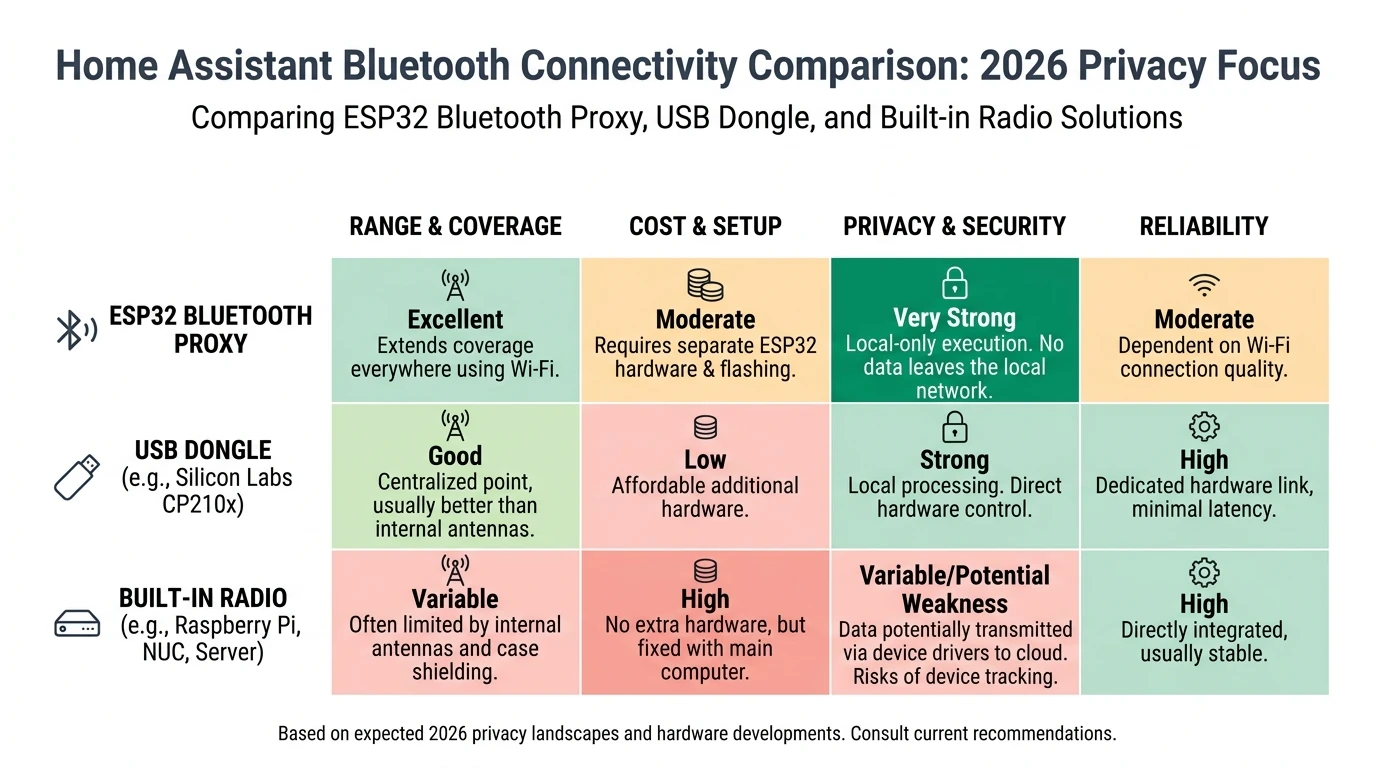
The ESP32 proxy stands out for its robust privacy features and cost-effectiveness. It operates entirely locally, forwarding raw Bluetooth Low Energy (BLE) packets without cloud involvement, which is crucial for users prioritizing data security. The USB dongle offers simplicity and ease of setup, making it a viable option for single-room applications where minimal configuration is desired. Meanwhile, the built-in radio option, often found in devices like the Raspberry Pi, provides a zero-cost solution but suffers from range limitations and potential interference issues.
Bottom line: For most users, the ESP32 proxy is the recommended choice due to its superior privacy controls, scalability, and affordability, especially when extending BLE sensor range across multiple rooms.
| Scenario | Prefer |
|---|---|
| Multi-floor BLE | Several ESP32 proxies |
| HA on NAS in a closet | USB on a short extension |
| Tight budget | Built-in + cable repositioning |
Understanding Bluetooth Proxy Options for Home Assistant
When integrating Bluetooth devices with Home Assistant, choosing the right proxy method is essential for achieving optimal performance and privacy. The three primary options—ESP32 proxy, USB dongle, and built-in radio—each offer distinct benefits and drawbacks. Understanding these can help you make an informed decision tailored to your smart home setup.
The ESP32 proxy is a versatile and cost-effective solution that integrates seamlessly with Home Assistant via ESPHome. It supports a wide range of BLE devices and offers extensive configuration options, including active GATT (Generic Attribute Profile) settings for enhanced privacy. This proxy method is particularly advantageous for users who require a distributed network of nodes to cover large areas or multiple rooms, as it allows for efficient roaming and fault tolerance.
In contrast, the USB dongle is a straightforward, plug-and-play option that requires minimal setup. It is ideal for users who need a quick and easy solution for a single room or small area. However, its range is limited, and it can become a single point of failure if not properly extended with USB cables or hubs.
The built-in radio, commonly found in devices like the Raspberry Pi, offers a no-cost entry point for Bluetooth integration. While convenient, it often struggles with range and reliability due to interference from other wireless signals, such as WiFi. This can lead to inconsistent performance, making it less suitable for environments where stable and reliable Bluetooth connectivity is critical.
Privacy and Local Control: Key Considerations
Privacy is a paramount concern for smart home enthusiasts, especially when dealing with Bluetooth devices that can potentially expose sensitive data. Each Bluetooth proxy option for Home Assistant offers different levels of privacy and local control, which are crucial factors to consider when making your choice.
The ESP32 proxy excels in privacy by operating entirely locally. It forwards raw BLE packets directly to Home Assistant without any cloud dependency, ensuring that your data remains within your local network. Additionally, the ESP32 supports configurable active GATT settings, allowing you to fine-tune the level of service caching and data exposure according to your privacy needs. This makes it an excellent choice for users who prioritize data security and wish to avoid any potential cloud-related privacy risks.
On the other hand, the USB dongle also supports local operation, provided that the Home Assistant server is configured to handle Bluetooth communications internally. While it does not inherently rely on cloud services, there is a potential risk of driver-related data leaks, although such incidents are rare and typically unverified. Users should ensure that their Home Assistant setup is secure and that any necessary security patches are applied promptly.
The built-in radio option offers local control but is susceptible to interference from other wireless signals, which can inadvertently expose data. This is particularly concerning in environments with heavy WiFi traffic, where Bluetooth signals may be compromised. Users opting for this solution should be aware of these risks and consider implementing additional security measures to safeguard their data.
Offline Reliability and Range Extension
For many Home Assistant users, offline reliability and the ability to extend Bluetooth range are critical factors in choosing a proxy method. Each option—ESP32 proxy, USB dongle, and built-in radio—offers varying levels of reliability and range, impacting their suitability for different home environments.
The ESP32 proxy is renowned for its offline reliability and ability to extend Bluetooth range effectively. By deploying multiple ESP32 nodes throughout your home, you can create a robust network that supports seamless roaming and fault tolerance. This distributed approach not only enhances coverage but also mitigates the risk of single-point failures, ensuring consistent performance even if one node goes offline. The ESP32’s ability to filter duplicate signals based on RSSI (Received Signal Strength Indicator) further improves reliability by minimizing interference and ensuring accurate data transmission.
In contrast, the USB dongle is limited by its range, typically covering only 10 to 20 meters. While it is a viable option for small spaces, its reliance on a single device makes it vulnerable to failures, particularly if the dongle is not positioned optimally. Users may need to invest in USB extension cables or hubs to improve coverage, which can increase the overall cost and complexity of the setup.
The built-in radio option offers the least reliable performance due to its susceptibility to interference and limited range. While it may suffice for basic applications in small areas, users seeking stable and extensive Bluetooth coverage should consider alternative solutions, such as adding external proxies or upgrading to more robust hardware.
Total Cost of Ownership: Evaluating Expenses
When selecting a Bluetooth proxy for Home Assistant, understanding the total cost of ownership (TCO) is essential for budgeting and long-term planning. Each option—ESP32 proxy, USB dongle, and built-in radio—comes with its own set of costs, both upfront and hidden, which can influence your decision.
The ESP32 proxy is a cost-effective choice, with individual boards priced between $3 and $10. This affordability makes it feasible to deploy multiple nodes throughout your home, providing extensive coverage at a relatively low cost. Additionally, the ESP32 operates with low power consumption, typically around 0.5 watts, which minimizes ongoing energy expenses. However, users should account for the potential need to purchase several units to achieve optimal coverage, as well as any additional costs associated with flashing and configuring the devices.
In comparison, the USB dongle has a higher upfront cost, ranging from $10 to $30. While it offers a simple and straightforward setup, users may incur additional expenses if they need to purchase USB extension cables or hubs to improve range and reliability. This can increase the overall cost, particularly if multiple dongles are required to cover larger areas.
The built-in radio option is the most economical in terms of initial cost, as it leverages existing hardware without requiring additional purchases. However, its limited range and reliability may necessitate further investment in external proxies or upgraded hardware to achieve satisfactory performance. Users should weigh these potential costs against the benefits of a no-cost entry point when considering this option.
Setup Complexity and Support Burden
The ease of setup and ongoing support requirements are important considerations when choosing a Bluetooth proxy for Home Assistant. Each option—ESP32 proxy, USB dongle, and built-in radio—varies in complexity and the level of support needed, impacting the user experience and long-term maintenance.
The ESP32 proxy requires initial setup through flashing with ESPHome, which may involve a learning curve for users unfamiliar with the process. However, once configured, the ESP32 integrates seamlessly with Home Assistant, offering automatic discovery and configuration of supported devices. The ongoing support burden is relatively low, with occasional firmware updates needed to maintain optimal performance. Users can benefit from a strong community and extensive documentation, which provide valuable resources for troubleshooting and customization.
In contrast, the USB dongle offers the simplest setup, with plug-and-play functionality that requires minimal configuration. This makes it an attractive option for users seeking a hassle-free solution. However, the lack of optimization for Home Assistant may result in limited support and troubleshooting resources, potentially increasing the burden if issues arise.
The built-in radio option offers zero setup requirements, as it utilizes existing hardware. While this provides convenience, users may encounter challenges related to interference and reliability, which can increase the support burden. The lack of dedicated support and documentation for built-in radios may necessitate additional research and experimentation to achieve satisfactory performance.
Privacy Score and Security Implications
When evaluating Bluetooth proxy options for Home Assistant, privacy and security are paramount considerations. Each option—ESP32 proxy, USB dongle, and built-in radio—offers different levels of privacy protection and security features, which can influence your decision.
The ESP32 proxy scores highly in privacy due to its local operation and configurable active GATT settings. By forwarding raw BLE packets directly to Home Assistant without cloud involvement, the ESP32 ensures that your data remains secure within your local network. Additionally, the ability to configure service caching and data exposure provides users with granular control over their privacy settings, making it an ideal choice for those who prioritize data security.
The USB dongle also supports local operation, provided that the Home Assistant server is configured to handle Bluetooth communications internally. While it does not inherently rely on cloud services, users should be aware of potential driver-related data leaks, although such incidents are rare and typically unverified. Ensuring that your Home Assistant setup is secure and up-to-date with the latest security patches is essential for maintaining privacy.
The built-in radio option offers local control but is susceptible to interference from other wireless signals, which can inadvertently expose data. This is particularly concerning in environments with heavy WiFi traffic, where Bluetooth signals may be compromised. Users opting for this solution should be aware of these risks and consider implementing additional security measures to safeguard their data.
Recommended Decision-Making Checklist
Checklist
- Assess your need for range extension and multi-room coverage.
- Evaluate privacy priorities and ensure local control.
- Consider offline reliability and potential single-point failures.
- Calculate total cost of ownership, including hidden expenses.
- Determine setup complexity and ongoing support requirements.
Frequently Asked Questions
Frequently Asked Questions
What is a Home Assistant Bluetooth proxy?
A Bluetooth proxy in Home Assistant extends the range of BLE devices, enabling local control without cloud dependency.
Why choose an ESP32 proxy over a USB dongle?
The ESP32 offers better privacy, scalability, and cost-effectiveness, making it ideal for multi-room setups.
Are there privacy risks with built-in radios?
Yes, built-in radios can suffer from interference, potentially exposing data in environments with heavy WiFi traffic.
How does offline reliability differ between options?
ESP32 proxies offer distributed reliability, while USB dongles and built-in radios may face single-point failures.
What are the hidden costs of using a USB dongle?
Hidden costs include USB extension cables or hubs needed to improve range and reliability.
Primary Sources Table
| Index | Title/Description | Direct URL |
|---|---|---|
| 1 | ESPHome Bluetooth Proxy for Home Assistant (ESP32 Guide) | Seeed Studio |
| 2 | ESP32 Bluetooth Proxy Home Assistant – 2026 Guide | ESP32.co.uk |
| 3 | Bluetooth Proxie for Home Assistant (Forum) | DIY Solar Forum |
| 4 | Home Assistant Bluetooth Proxy: Ultimate 2026 Guide | TecnoyFoto |
| 5 | Bluetooth proxies are simple tech to deploy in smart home | XDA |
| 6 | Shelly Gen 3 Bluetooth Proxy (HA Community) | HA Community |
| 7 | ESPHome GitHub Issue: Bluetooth proxies regression | GitHub |
| 8 | Bluetooth Proxy - ESPHome Official Docs | ESPHome |
Conclusion
In conclusion, selecting the right Bluetooth proxy for Home Assistant involves balancing privacy, reliability, and cost. The ESP32 proxy emerges as the most versatile and secure option, offering extensive coverage and robust privacy controls. For users seeking simplicity, the USB dongle provides an easy setup, while the built-in radio offers a cost-effective, albeit limited, solution.
Explore related guides on smart home privacy and hardware options for further insights: