Smart Home Privacy
Athom vs Shelly Plus vs Eve Energy: Privacy 2026
Athom HomeKit plug vs Shelly Plus PM vs Eve Energy in 2026: Thread vs Wi-Fi Matter, when Homebridge is worth it, and keeping energy telemetry on your LAN.
Quick answer: Athom, Shelly Plus PM, or Eve Energy for a private HomeKit + Home Assistant setup?
Eve Energy on Thread keeps power reporting inside Apple’s local fabric when you avoid Eve Cloud extras. Shelly Plus adds MQTT and Wi-Fi flexibility for HA-first homes. Athom is inexpensive but often routes through Homebridge—treat the bridge as part of your threat model.
Source: Home Assistant Matter
Executive Summary
In 2026, choosing a smart plug that prioritizes local privacy and HomeKit compatibility involves evaluating options like Athom, Shelly Plus, and Eve Energy. Cross-read best smart plugs without cloud, Shelly Gen3 vs Gen4 vs Tuya, and Matter hubs local vs cloud.
Bottom line: For those prioritizing privacy and local control, Eve Energy is the top choice, while Shelly Plus offers flexibility, and Athom provides a budget-friendly option with some setup complexity.
| Plug | Best for |
|---|---|
| Eve Energy | Thread + Apple-first, minimal cloud surface |
| Shelly Plus PM | MQTT/Home Assistant power users |
| Athom | Budget + existing Homebridge host |
Privacy and Local Control
Privacy is a critical concern for smart home users, especially when it comes to smart plugs that can potentially track energy usage and other data. In 2026, the landscape for smart plugs has evolved to prioritize local control, minimizing cloud dependencies. Eve Energy excels in this area by offering a fully local solution with no cloud accounts required. It uses Thread for reliable mesh networking and Matter for standard-based privacy, ensuring that your data remains within your home network[^5][^7].
Shelly Plus, on the other hand, provides local data storage with 16MB of flash memory, allowing users to keep their data private. It supports Matter over Wi-Fi, which facilitates local control, although full functionality may require the Shelly app, which can introduce optional cloud interactions[^6][^8]. This makes Shelly Plus a versatile choice for users who want to balance privacy with feature-rich capabilities.
Athom relies on Homebridge for HomeKit compatibility, which can offer local control if configured correctly. However, this setup can be complex and may inadvertently introduce cloud dependencies if not properly managed[^4]. Users must ensure their Homebridge setup is secure to maintain privacy.
Offline Reliability
When it comes to offline reliability, the ability of a smart plug to function without internet access is crucial. Eve Energy offers robust offline capabilities, leveraging Thread’s mesh network to maintain stable local automations. This ensures that your smart home continues to function seamlessly even during internet outages[^5][^7].
Shelly Plus also provides reliable offline functionality through its local scenes feature, which can be configured via the Shelly app. This allows users to set up automations that operate independently of cloud services, although some advanced features may still require internet access[^6][^8]. The Matter protocol further enhances its offline reliability by standardizing local control.
Athom’s offline reliability is contingent on the stability of the Homebridge setup. While it can support basic local operations, any issues with the Homebridge server could impact performance. Users should ensure their Homebridge is regularly updated and secured to maintain offline functionality[^4].
Total Cost of Ownership
Understanding the total cost of ownership (TCO) is essential when selecting a smart plug, as it encompasses not only the initial purchase price but also any additional costs for hubs or energy monitoring accessories. Eve Energy, priced between $40 and $50 per unit, does not require a hub or subscription, making it a straightforward choice with predictable costs[^7].
Shelly Plus is more affordable, ranging from $25 to $40 per unit. It does not require a hub, but users may need the Shelly app for full functionality, which could introduce optional costs if cloud features are desired[^6][^8]. Its high power capacity reduces the need for multiple units, further lowering TCO.
Athom is the most budget-friendly option at approximately $20 per unit. However, it requires a Homebridge server, which can add $50 or more to the initial setup cost. Over three years, the TCO for Athom can reach $70, factoring in energy consumption and server maintenance[^4].
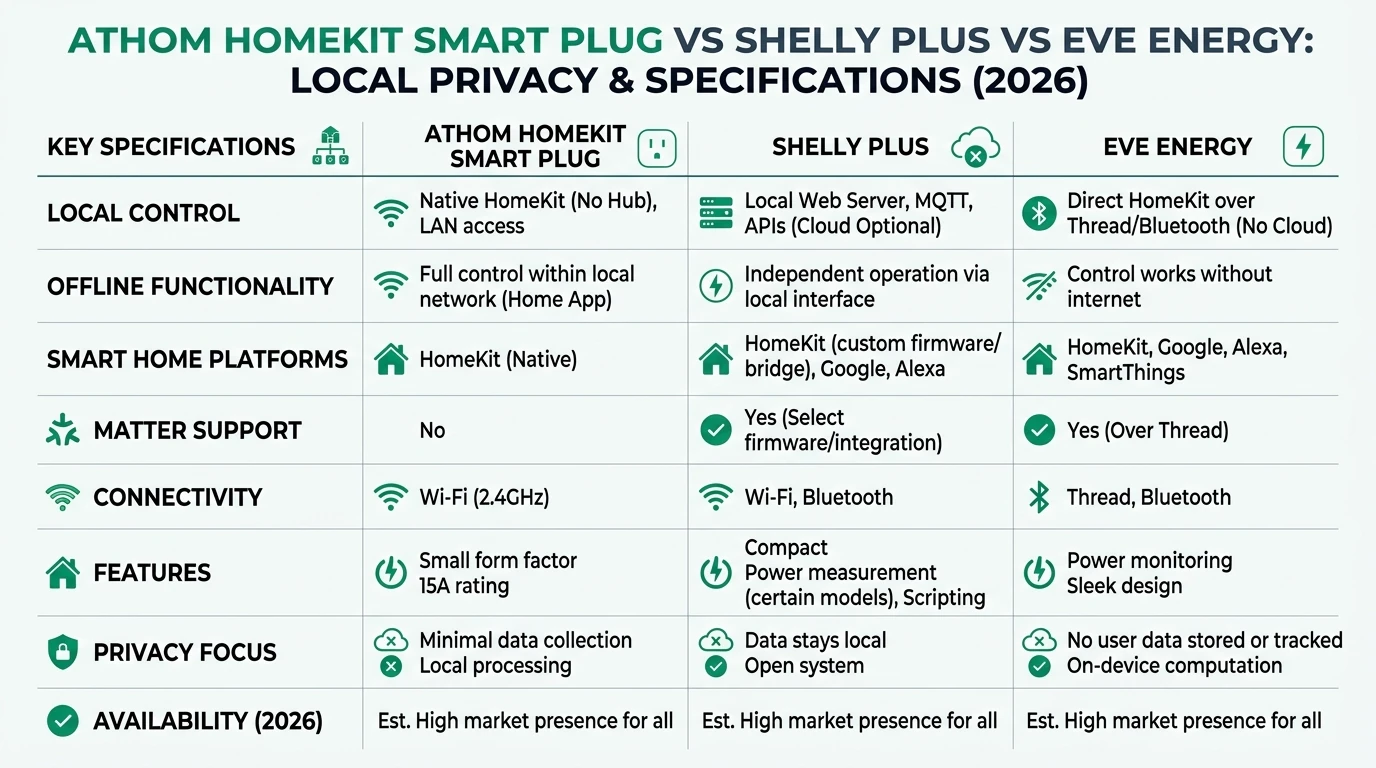
| Criterion | Athom (HomeKit via Homebridge) | Shelly Plus (e.g., Plug S/1PM Gen3) | Eve Energy |
|---|---|---|---|
| Privacy | Local via Homebridge; potential cloud if bridged wrong | Matter over Wi-Fi; local metrics, app optional | No cloud/accounts; fully local Matter/Thread |
| Offline Reliability | Bridge-dependent; basic local | Local scenes via app; Matter basic | Local automations; Thread mesh stable |
| Power Rating | Varies (not specified) | 2500-3000W | Not specified; energy reporting |
| TCO (est. 1 unit, 3 yrs) | $20-30 + Homebridge setup | $25-40; no hub | $40-50; no hub/sub |
Product Ecosystem and Compatibility
The ecosystem and compatibility of a smart plug can significantly influence its usability and integration into your smart home. Eve Energy is deeply integrated with Apple’s ecosystem, supporting HomeKit, Matter, and Thread. This makes it an excellent choice for Apple users seeking seamless integration and local control[^5][^7].
Shelly Plus offers a more versatile approach, supporting multiple protocols including Matter, Wi-Fi, and Zigbee. This makes it suitable for users with diverse smart home setups who require compatibility across different platforms[^6][^8]. Its local data storage and power metering capabilities further enhance its appeal for tech-savvy users.
Athom, while not natively supporting Matter, can be integrated into HomeKit via Homebridge. This allows users to leverage HomeKit’s ecosystem, albeit with some setup complexity. Athom’s budget-friendly nature and wide range of plugins make it a viable option for those willing to invest time in configuration[^4].
Checklist
- Eve Energy for Apple ecosystems
- Shelly Plus for multi-protocol support
- Athom for budget-conscious users with Homebridge
Security and Privacy Implications
Security and privacy are paramount when choosing a smart plug, as these devices can potentially expose sensitive data. Eve Energy prioritizes local-only control, eliminating the need for cloud accounts and minimizing data exposure. Its use of Thread and Matter ensures secure, standards-based communication within your home network[^5][^7].
Shelly Plus offers local data storage and supports Matter, providing a secure environment for your data. However, users should be aware that full functionality may require the Shelly app, which could introduce optional cloud interactions[^6][^8]. Ensuring that these interactions are disabled can help maintain privacy.
Athom’s reliance on Homebridge introduces potential security risks if not properly configured. Users must ensure their Homebridge setup is secure and regularly updated to prevent vulnerabilities[^4]. While Matter improves interoperability, it also requires careful management to maintain privacy.
Setup Complexity and Support Burden
The complexity of setting up a smart plug can influence your overall experience and satisfaction. Eve Energy offers a straightforward setup process with app-guided instructions and Thread pairing, minimizing the need for technical support. Firmware updates are delivered over-the-air, ensuring your device remains up-to-date with minimal effort[^5][^7].
Shelly Plus provides open-source HomeKit support and Matter auto-discovery, simplifying the setup process. However, users may prefer using the Shelly app for full functionality, which can introduce some complexity[^6][^8]. Early-stage limitations, such as incomplete power metering in HomeKit, may require additional configuration.
Athom requires Homebridge installation, which can be complex and time-consuming. Users must manage plugins and updates manually, increasing the support burden. While this setup allows for extensive customization, it may not be suitable for users seeking a plug-and-play solution[^4].
Price Model and Hidden Costs
Understanding the price model and potential hidden costs is crucial when selecting a smart plug. Eve Energy, priced between $40 and $50, offers a transparent cost structure with no additional hub or subscription fees. This makes it an attractive option for users seeking predictable expenses[^7].
Shelly Plus is more affordable, with prices ranging from $25 to $40 per unit. While it does not require a hub, users may need the Shelly app for full functionality, which could introduce optional costs if cloud features are desired[^6][^8]. Its high power capacity reduces the need for multiple units, further lowering TCO.
Athom is the most budget-friendly option at approximately $20 per unit. However, it requires a Homebridge server, which can add $50 or more to the initial setup cost. Over three years, the TCO for Athom can reach $70, factoring in energy consumption and server maintenance[^4].
FAQ
Frequently Asked Questions
What is the best local HomeKit plug in 2026?
Eve Energy is the best local HomeKit plug in 2026, offering local-only control with Matter and Thread support, ensuring privacy and reliability.
How does Shelly Plus ensure privacy?
Shelly Plus ensures privacy through local data storage and Matter support, although full functionality may require the Shelly app, which can introduce optional cloud interactions.
Is Athom a good choice for budget-conscious users?
Yes, Athom is a budget-friendly option, but it requires Homebridge for HomeKit integration, which can add complexity and potential hidden costs.
Can Eve Energy operate offline?
Yes, Eve Energy can operate offline using Thread’s mesh network, maintaining stable local automations even during internet outages.
What are the hidden costs of using Athom smart plugs?
The hidden costs of using Athom smart plugs include the need for a Homebridge server, which can add $50 or more to the initial setup cost.
Primary Sources Table
| Index | Title/Description | Direct URL |
|---|---|---|
| 1 | Back for another try - Off-Topic - Homey Community Forum | Homey Community |
| 2 | Homey — A better smart home - App Store | App Store |
| 3 | SHELLY HomeKit Support (Open Source) - SmarterHOME | SmarterHOME |
| 4 | Homebridge | Homebridge |
| 5 | Eve Unveils its First North American Thermostat… | HomeKit News |
| 6 | Shelly Announces Additional Matter Products for 2026 | Matter-SmartHome.de |
| 7 | HomeKit Weekly: Eve Energy gains Matter energy reporting… | 9to5Mac |
| 8 | Shelly Apple HomeKit Integration | Shelly |
Conclusion
In conclusion, the choice between Athom, Shelly Plus, and Eve Energy smart plugs in 2026 largely depends on your priorities regarding privacy, local control, and cost. Eve Energy is the top choice for privacy-focused users within the Apple ecosystem, offering seamless local control with Matter and Thread support. Shelly Plus provides a versatile, multi-protocol solution with local data storage, ideal for users who value flexibility and advanced features. Athom, while budget-friendly, requires Homebridge for HomeKit integration, adding complexity but offering a cost-effective solution for tech-savvy users.
For further insights on smart home privacy, explore our guides on Apple HomeKit Secure Video vs Local NVR for Privacy, Aqara vs Shelly vs Tuya Privacy 2026, Best Hardware for Local AI Smart Home 2026, WLED vs Hue vs Zigbee lighting, and smart home energy monitors.