Smart Home Privacy
Wi-Fi 6E vs Wi-Fi 7: Smart Home IoT Privacy 2026
Wi-Fi 6E vs Wi-Fi 7 for smart homes in 2026: 6 GHz vs MLO, IoT airtime, segmenting guest and IoT SSIDs, and why Wi-Fi privacy still needs VLAN policy.
Quick answer: Wi-Fi 6E or Wi-Fi 7 for a privacy-focused smart home in 2026?
Wi-Fi 7 adds Multi-Link Operation and higher PHY rates for dense homes. Wi-Fi 6E already opens clean 6 GHz spectrum. Neither replaces network policy—pair new APs with IoT VLANs and DNS filtering.
Source: Wi-Fi Alliance
Executive Summary
As smart homes evolve, the demand for robust and efficient wireless networks has never been greater. Wi-Fi 6E and Wi-Fi 7 each offer unique benefits for managing IoT congestion. Reference overviews: Wi-Fi Alliance — Wi-Fi 6E and IEEE 802.11be (Wi-Fi 7) project. Cross-read best smart home mesh for privacy, guest Wi-Fi vs IoT VLAN, and OpenWrt vs stock firmware.
The choice between Wi-Fi 6E and Wi-Fi 7 hinges on your specific needs. If your smart home setup involves a high number of IoT devices, Wi-Fi 7’s superior capacity and speed will likely serve you better. However, for those with fewer devices and a focus on cost-effectiveness, Wi-Fi 6E remains a viable option. Both standards support the Matter and Thread protocols, which are crucial for ensuring interoperability and privacy in smart home ecosystems.
Bottom line: Wi-Fi 7 is the superior choice for future-proofing your smart home, but Wi-Fi 6E offers a balanced approach for current needs.
| Decision lens | Pick |
|---|---|
| Many Wi-Fi IoT clients + 4K local cameras | Wi-Fi 7 APs when clients catch up |
| Solid 6 GHz today, tighter budget | Wi-Fi 6E |
| Privacy | Same SSID segmentation and firewall rules either way |
Understanding Wi-Fi 6E and Wi-Fi 7: Key Differences
Wi-Fi 6E and Wi-Fi 7 represent significant advancements in wireless technology, each tailored to meet the growing demands of smart home environments. Wi-Fi 6E extends the capabilities of Wi-Fi 6 by utilizing the 6 GHz band, which offers a less congested spectrum for devices. This additional band helps reduce interference and improve performance in environments with many connected devices.
Wi-Fi 7, on the other hand, is designed to handle even more devices simultaneously. It supports up to 320 MHz channels, compared to the 160 MHz channels of Wi-Fi 6E, effectively doubling the bandwidth available for data transmission. This increase in channel width, combined with Multi-Link Operation (MLO), allows Wi-Fi 7 to manage multiple data streams across different frequency bands, significantly enhancing throughput and reducing latency.
The theoretical maximum speed of Wi-Fi 7 is 46 Gbps, a substantial leap from the 9.6 Gbps offered by Wi-Fi 6E. This increase in speed is particularly beneficial for applications requiring high data rates, such as 4K video streaming and virtual reality. Additionally, Wi-Fi 7’s improved latency performance makes it ideal for real-time applications like gaming and video conferencing, which are becoming increasingly common in smart home setups.
In summary, while Wi-Fi 6E provides a significant improvement over its predecessors by offering a cleaner spectrum, Wi-Fi 7’s enhancements in speed, capacity, and latency make it the more future-proof option for smart homes. However, the choice between the two should be guided by your current and anticipated needs, particularly the number of devices and the types of applications you plan to support.
Smart Home IoT Congestion: Capacity and Performance
The proliferation of IoT devices in smart homes has led to increased network congestion, making it crucial to choose a wireless standard that can handle multiple connections efficiently. Wi-Fi 6E and Wi-Fi 7 both address this challenge, but in different ways.
Wi-Fi 6E can support around 40-50 connected devices before performance begins to degrade. This is adequate for many current smart home setups, where the number of devices typically ranges from 20 to 30. However, as the number of connected devices continues to grow, Wi-Fi 6E may struggle to maintain optimal performance.
Wi-Fi 7, with its ability to support 100-200+ devices, offers a more robust solution for managing IoT congestion. This increased capacity is achieved through the use of wider channels and MLO, which allows for simultaneous communication across multiple bands. As a result, Wi-Fi 7 can maintain high performance even in environments with a large number of connected devices.
For smart home owners planning to expand their IoT ecosystems, Wi-Fi 7 provides the scalability needed to accommodate future growth. Its superior device capacity and performance make it an ideal choice for homes with extensive smart home setups, ensuring that all devices can operate smoothly without interference or lag.
In conclusion, while Wi-Fi 6E is suitable for current smart home needs, Wi-Fi 7 offers the capacity and performance necessary to support the growing number of IoT devices expected in the coming years. This makes Wi-Fi 7 the preferred choice for future-proofing your smart home network.
Privacy and Security in Smart Home Networks
Privacy and security are paramount concerns in smart home networks, where sensitive data is transmitted between devices. Both Wi-Fi 6E and Wi-Fi 7 incorporate advanced security features to protect your network from unauthorized access and data breaches.
Wi-Fi 6E supports WPA3, the latest security protocol that offers enhanced encryption and protection against brute-force attacks. This ensures that your smart home devices are safeguarded against common security threats. Additionally, the use of the 6 GHz band in Wi-Fi 6E reduces the risk of interference from neighboring networks, further enhancing security.
Wi-Fi 7 builds on these security features by introducing even more robust encryption methods and improved authentication protocols. This makes it more resistant to sophisticated cyberattacks, providing an additional layer of security for your smart home network. Furthermore, Wi-Fi 7’s support for MLO allows for more secure data transmission across multiple bands, reducing the risk of data interception.
The Matter and Thread protocols, which are compatible with both Wi-Fi 6E and Wi-Fi 7, also play a crucial role in ensuring privacy and security in smart home ecosystems. These protocols facilitate secure communication between devices, ensuring that data is transmitted only between authorized devices and users.
In summary, both Wi-Fi 6E and Wi-Fi 7 offer strong security features to protect your smart home network. However, Wi-Fi 7’s enhanced encryption and authentication protocols provide an additional level of security, making it the better choice for those who prioritize privacy and security in their smart home setups.
Practical Considerations for 2026: Choosing the Right Standard
When deciding between Wi-Fi 6E and Wi-Fi 7 for your smart home, several practical considerations should guide your choice. These include the number of devices you plan to connect, the types of applications you use, and your budget.
For households with a moderate number of devices and a focus on cost-effectiveness, Wi-Fi 6E remains a viable option. It offers a good balance of performance and price, making it suitable for most current smart home setups. Additionally, its support for the 6 GHz band provides a cleaner spectrum, reducing interference and improving performance.
However, if you anticipate a significant increase in the number of connected devices or plan to use data-intensive applications, Wi-Fi 7 is the better choice. Its superior speed, capacity, and latency performance make it ideal for future-proofing your smart home network. While Wi-Fi 7 may come with a higher initial cost, its long-term benefits in terms of performance and scalability make it a worthwhile investment.
It’s also important to consider the compatibility of your existing devices with the new standard. While most modern devices are compatible with Wi-Fi 6E, Wi-Fi 7 may require upgrading some of your older devices to fully leverage its capabilities.
In conclusion, the choice between Wi-Fi 6E and Wi-Fi 7 should be guided by your specific needs and future plans for your smart home. By carefully considering these factors, you can select the wireless standard that best meets your requirements and ensures a seamless smart home experience.
Checklist
- Evaluate the number of connected devices
- Consider future expansion plans
- Assess budget constraints
- Check device compatibility
- Prioritize security features
Visualizing the Future: Wi-Fi 6E vs Wi-Fi 7
To better understand the differences between Wi-Fi 6E and Wi-Fi 7, it’s helpful to visualize their key features and benefits. The following infographic provides a concise comparison of these two wireless standards, highlighting their respective strengths and applications in smart home environments.
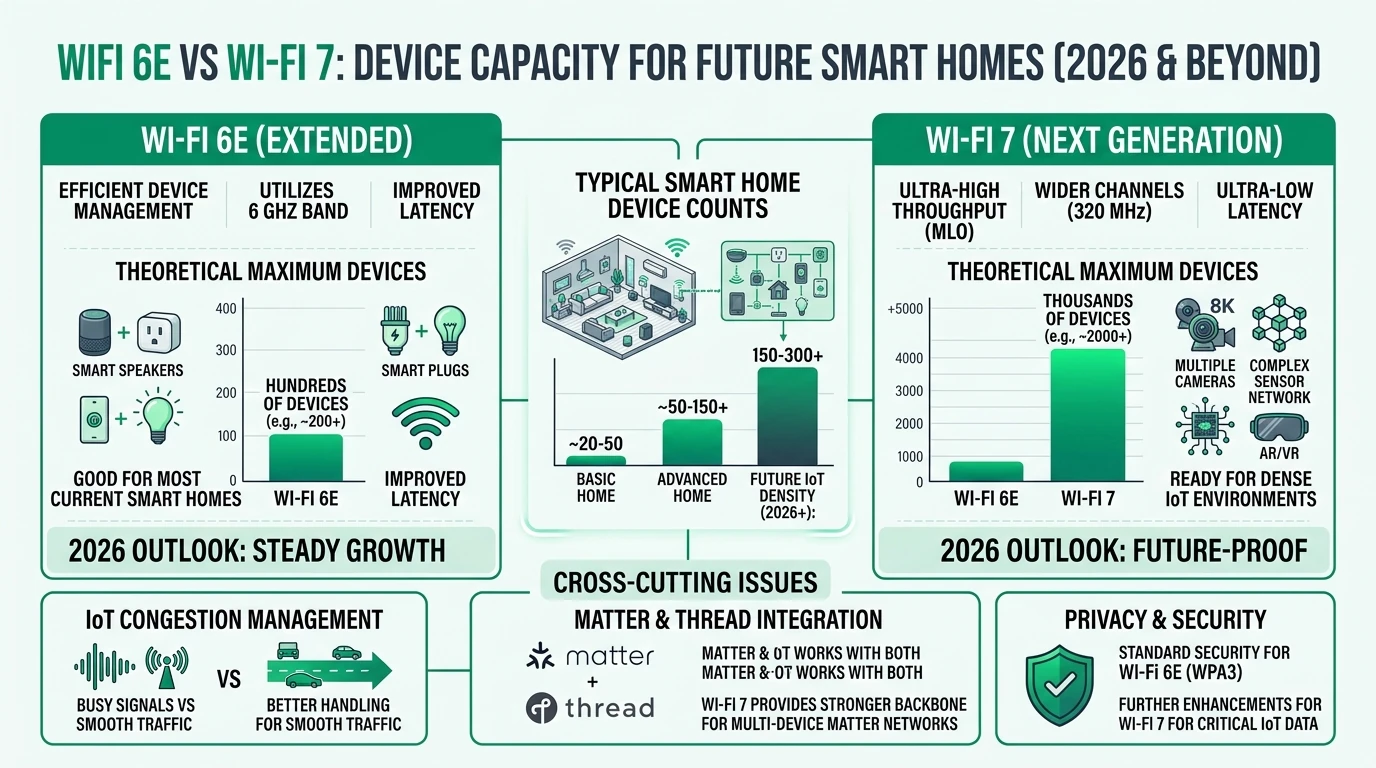
As depicted in the infographic, Wi-Fi 7 offers significant improvements in speed, capacity, and security, making it the preferred choice for future-proofing your smart home. However, Wi-Fi 6E remains a cost-effective option for those with fewer devices and a focus on current needs.
FAQ
Frequently Asked Questions
What is the main difference between Wi-Fi 6E and Wi-Fi 7?
Wi-Fi 7 offers higher speeds, greater device capacity, and improved latency compared to Wi-Fi 6E, making it more suitable for future smart home setups.
Is Wi-Fi 7 compatible with older devices?
While Wi-Fi 7 is backward compatible with older Wi-Fi standards, some older devices may not fully leverage its advanced features.
How does Wi-Fi 7 improve smart home privacy?
Wi-Fi 7 enhances privacy through advanced encryption and authentication protocols, reducing the risk of unauthorized access and data breaches.
Should I upgrade to Wi-Fi 7 if I already have Wi-Fi 6E?
Consider upgrading to Wi-Fi 7 if you plan to expand your smart home ecosystem or require higher performance for data-intensive applications.
What role do Matter and Thread play in smart home networks?
Matter and Thread facilitate secure communication between smart home devices, ensuring interoperability and enhancing privacy.
Primary Sources Table
| ID | Title / Description | Direct URL |
|---|---|---|
| 1 | Wi-Fi Alliance — Discover Wi-Fi 6E | wi-fi.org |
| 2 | IEEE 802.11be task group update | IEEE 802.11 |
| 3 | Qualcomm — What is Wi-Fi 7 | Qualcomm |
Conclusion
In the rapidly evolving landscape of smart home technology, choosing the right wireless standard is crucial for ensuring optimal performance and privacy. Wi-Fi 6E and Wi-Fi 7 each offer unique advantages, but Wi-Fi 7’s superior speed, capacity, and security make it the preferred choice for future-proofing your smart home. By carefully considering your specific needs and future plans, you can select the wireless standard that best meets your requirements and ensures a seamless smart home experience.
For more insights on smart home privacy, explore our guides on Apple HomeKit Secure Video vs Local NVR for Privacy, Aqara vs Shelly vs Tuya Privacy 2026, Best Hardware for Local AI Smart Home 2026, Pi-hole vs AdGuard, and Tailscale vs WireGuard.