Smart Home Privacy
Philips Hue Bridge vs Conbee II: Privacy 2026
Hue Bridge v4 versus Conbee II Zigbee coordinator for Home Assistant: cloud tie-ins, firmware updates, Zigbee mesh control, and which keeps lighting data local in 2026.
Quick answer: Hue Bridge or Conbee II for privacy with Home Assistant?
Conbee II (deCONZ/ZHA) keeps the Zigbee coordinator on hardware you own with no mandatory Signify account path. Hue Bridge works beautifully with first-party bulbs but encourages Hue app/cloud workflows—fine if you firewall the bridge and pair bulbs to HA, but still another vendor OS on your LAN.
Source: Zigbee2MQTT documentation
Executive Summary
Philips Hue ships the Hue Bridge as the official Zigbee coordinator for Hue bulbs, switches, and accessories. The Conbee II (and newer Conbee III) is a USB Zigbee stick that exposes a local API for deCONZ or ZHA inside Home Assistant1. Both can live entirely on your LAN, but update channels, pairing UX, and vendor incentives differ.
Pair this read with Zigbee2MQTT vs ZHA vs deCONZ and WLED vs Hue vs generic Zigbee.
Bottom line: Choose Hue Bridge for frictionless Hue ecosystem support; choose Conbee II when you want generic Zigbee ownership without Hue’s bridge firmware cadence.
Architecture and trust boundaries
The Hue Bridge runs embedded Linux maintained by Signify. It periodically checks for updates and may reach vendor endpoints unless you block them at the firewall—test carefully so you do not brick pairing2. Conbee II relies on your Home Assistant host for CPU, storage, and backups; the stick is “dumb radio + firmware” with a documented REST/WebSocket API via deCONZ or native ZHA.
| Component | Hue Bridge | Conbee II + HA |
|---|---|---|
| Firmware owner | Signify | Dresden Elektronik + your HA update policy |
| Pairing UX | Hue app (cloud login) | HA UI / Phoscon |
| Backup | Hue cloud account optional | Full host backup |
Pairing Hue bulbs without permanent cloud reliance
Many users pair Hue bulbs to Conbee II or Sonoff/Zigbee2MQTT to avoid the Hue app entirely3. Hue Bridge can still work LAN-only after setup if outbound traffic is blocked—verify scenes and firmware updates still meet your needs. Some Hue accessories remain easier on official firmware.
Performance, mesh, and interference
Both coordinators support Zigbee mesh through routers (bulbs, plugs). Conbee II on USB extension cable reduces USB 3.0 interference—same best practice as any coordinator4. Hue Bridge placement matters less for aesthetics but still needs Ethernet backhaul.
| Topic | Hue Bridge | Conbee II |
|---|---|---|
| Max devices (typical) | Hue-documented limits | Depends on map; plan ~40–60 end devices prudently |
| USB placement | N/A (Ethernet) | Use shielded extension |
Hue Entertainment, sync boxes, and hidden cloud paths
Hue Entertainment areas and HDMI sync features often expect Hue cloud or vendor apps for DRM-heavy content5. If your goal is purely LAN lighting scenes, disable entertainment features you do not need. Conbee II setups rarely expose these proprietary pathways—another reason privacy-focused users migrate generic Zigbee bulbs to HA-native scenes.
Network placement on IoT VLANs
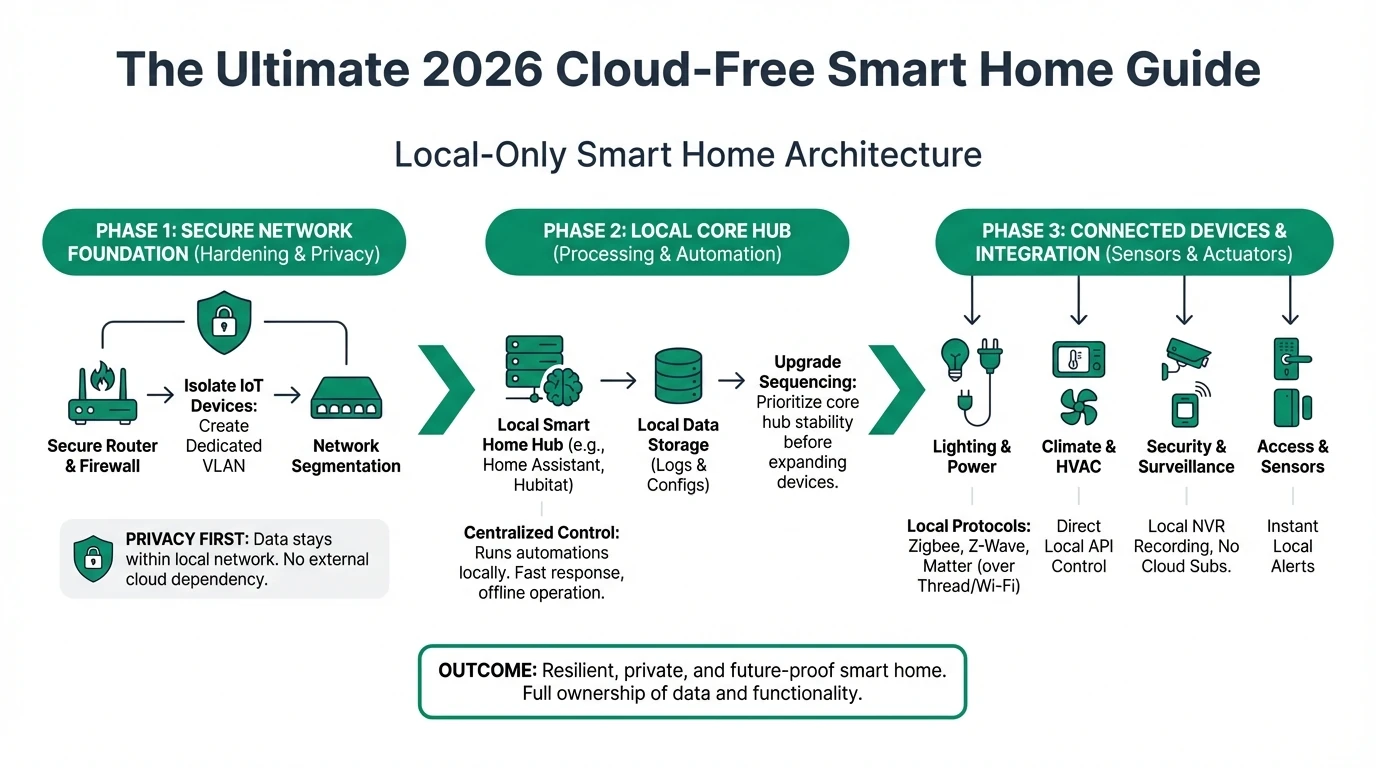
Place either coordinator on the same Layer-2 segment as Zigbee routers for mesh stability. If you VLAN-split IoT from user LAN, configure mDNS reflectors carefully—see our dedicated mDNS across VLANs guide so phones can discover HA without blasting multicast everywhere.
Privacy scoring dimensions
| Factor | Hue Bridge | Conbee II |
|---|---|---|
| Mandatory account for daily use | Often (Hue app) | No |
| Open API | Partial (local API + app) | Yes (REST/WebSocket) |
| Vendor analytics | Hue app telemetry | None from stick alone |
Operational cost and failure modes
Hue Bridge hardware is premium-priced but stable. Conbee II is inexpensive but ties reliability to your HA host—follow backup best practices. If HA dies, Zigbee network state lives on the stick—keep spare hardware.
When Hue Bridge still wins
Hue Bridge remains the fastest path for Hue Secure cameras, Hue Sync, and official warranty support—if those features matter, keep the bridge firewalled and accept Signify’s update channel. Pure lighting users who never open the Hue app after pairing can still prefer Conbee + HA for transparent Zigbee control.
Migration path
- Inventory bulbs and confirm Zigbee vs Hue-only features.
- If moving to Conbee, reset bulbs per manufacturer procedure and re-pair.
- Rebuild scenes in HA; test off-hours to avoid family revolt.
Checklist
- Document current Hue scenes and automations before migrating radios.
- Put coordinators on UPS-backed switches and label Zigbee channel.
- Block WAN egress for test VLANs only after validating local control.
- Export Home Assistant Zigbee network backup if your stack supports it.
- Schedule firmware updates during maintenance windows.
FAQ
Frequently Asked Questions
Can I run Hue Bridge without internet forever?
LAN control may persist, but firmware and account recovery may require temporary internet—plan maintenance windows instead of permanent air-gap unless you accept stale firmware.
Is Conbee II harder than Hue Bridge?
Yes—Phoscon/ZHA UIs are technical. Hue optimizes consumer UX at the cost of vendor control.
Will Hue accessories work on Conbee?
Many do, but some Hue-specific features (Entertainment sync, certain switches) map imperfectly—check community device databases.
Should I buy Conbee III instead?
Newer silicon may offer better RF; verify Home Assistant integration maturity before buying.
Does Matter replace this decision?
Matter changes device onboarding, but Zigbee remains relevant for years—see Matter vs Zigbee vs Z-Wave.
Primary sources
| ID | Source | URL |
|---|---|---|
| 1 | deCONZ REST API | dresden-elektronik.de |
| 2 | Philips Hue developer | developers.meethue.com |
| 3 | Zigbee2MQTT devices | zigbee2mqtt.io |
Conclusion
Hue Bridge is the low-friction path for Hue-heavy homes willing to manage Hue’s cloud touchpoints. Conbee II is the privacy-flexible path when you want Zigbee under your OS and are comfortable with HA operations. Next step: compare Sonoff vs SLZB06 vs Conbee if you want Ethernet-attached coordinators instead of USB.
Footnotes
-
Conbee II exposes a documented local API usable from Home Assistant via ZHA or deCONZ integrations. ↩
-
Hue Bridge update behavior depends on Signify firmware policies—review release notes before blocking WAN. ↩
-
Community migrations from Hue Bridge to universal coordinators are widely documented for Home Assistant users. ↩
-
Zigbee best practices recommend USB extension cables away from USB 3.0 interference sources. ↩
-
Hue Entertainment and HDMI sync features may require vendor services and LAN discovery—review Hue’s feature requirements before enabling. ↩