Comparisons
mmWave vs PIR: Presence Sensors HA 2026
Compare mmWave radar and PIR motion sensors for Home Assistant: occupancy vs movement, false triggers, privacy, placement, and when to combine both locally.
Quick answer: Should I use mmWave or PIR for Home Assistant presence?
Use PIR for simple motion-activated lights and coarse triggers on a budget. Use mmWave when you need true occupancy (stillness while seated) and fewer false clears. For bathrooms and desks, mmWave wins; for hallways and perimeter alerts, PIR often suffices.
Executive Summary
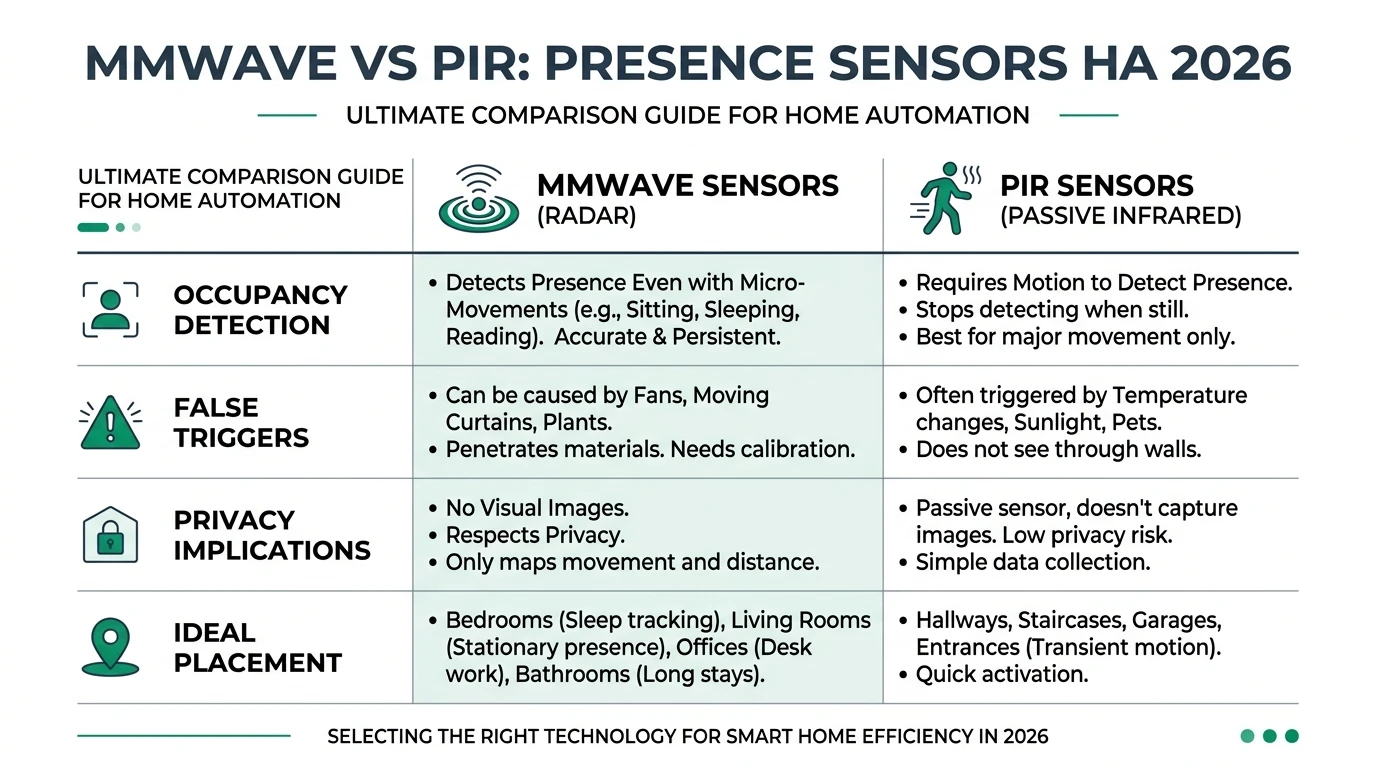
PIR (passive infrared) sensors detect changes in heat from moving bodies. mmWave (60 GHz FMCW radar on many consumer boards) detects micro-motion and distance, which maps better to presence than to “someone waved an arm.” This guide compares both for local-first Home Assistant setups—stack with cloud-free sensors, Zigbee2MQTT vs ZHA, and lighting decisions.
Bottom line: Budget and wiring often point to PIR; comfort and automation quality often justify mmWave where occupancy matters.
How detection differs
| Aspect | PIR | mmWave |
|---|---|---|
| Primary signal | Infrared heat delta | RF reflection / Doppler |
| Still person seated | Often no update | Often yes (depends on sensitivity) |
| Sun / radiator drift | Can false-trigger | Less sensitive to IR glare |
| Through glass | Usually blocked | Can see through thin barriers (varies) |
| Typical cost | Lower | Higher |
Privacy posture
Neither technology needs a camera in the room, which is why both are popular for privacy-minded automations1. The tradeoff is different:
| Concern | PIR | mmWave |
|---|---|---|
| Visual surveillance | None | None |
| Room mapping | Coarse | Finer range bins on some devices |
| RF exposure | N/A | Low-power consumer radars; follow manufacturer placement |
For camera-based presence, compare Frigate and alternatives—different threat model entirely. If sensors cross subnets, plan mDNS carefully.
Automation patterns in Home Assistant
| Use case | Suggested sensor |
|---|---|
| Hallway motion → light | PIR |
| Office desk occupancy | mmWave |
| Bathroom fan / light timeout | mmWave or dual-tech |
| Alarm perimeter | PIR + door sensors |
Use groups or template sensors to combine inputs and debounce flaky edges. Prefer local push (Zigbee, Z-Wave, ESPHome) over cloud bridges when possible—see hub comparisons.
Placement and tuning
| Tip | PIR | mmWave |
|---|---|---|
| Height | 2–2.5 m typical | Follow vendor (often chest height for presence) |
| Facing | Lens field of view | Avoid aiming at vibrating objects / fans |
| Debounce | Longer off delay | Tune sensitivity and distance if exposed in UI |
When to use both
A practical stack: PIR at the door path for instant “someone entered,” mmWave deeper in the room for holding lights on during still work. This reduces flicker and stale occupancy compared to either alone.
Checklist
- Define whether you need motion edges or sustained presence before buying.
- Confirm Zigbee/Z-Wave/MQTT path into Home Assistant.
- Test automations at night and with HVAC fans running.
- Avoid pointing mmWave at metal blinds or rotating machinery.
- Document entity names for household members who tweak scenes later.
FAQ
Frequently Asked Questions
Is mmWave better than PIR for sleep detection?
Neither replaces medical devices; for lights-off automations, mmWave can help detect stillness patterns but product firmware varies widely.
Do mmWave sensors work through walls?
Some energy can leak through thin partitions—mount and angle carefully to avoid cross-room triggers.
Can I run these without cloud accounts?
Yes—prefer Zigbee/Z-Wave/ESPHome paths integrated locally into Home Assistant.
Why does my PIR miss me at my desk?
PIR needs noticeable heat motion; small typing motion may not register—switch to mmWave or add a second trigger.
Are false triggers worse on PIR or mmWave?
PIR struggles with heat/sun/fans; mmWave struggles with vibrating metal and some appliances—tuning differs.
Primary sources
| ID | Source | URL |
|---|---|---|
| 1 | Home Assistant motion | home-assistant.io |
| 2 | Zigbee2MQTT docs | zigbee2mqtt.io |
Conclusion
mmWave vs PIR is not a single winner—it is a physics vs price choice. Start from the automation story (motion vs occupancy), buy hardware that fits your radio stack, and iterate thresholds in real rooms before locking in scenes.
Footnotes
-
Absence of video does not mean “zero data”—automation logs still exist on your hub; scope backups accordingly. ↩